



Smart Fitness Mirrors: You Are What You see
 The “Smart Mirror” category exploded onto the market with the launch of Mirror (now Lululemon Studio) in 2018. This technology introduced a new paradigm for home gyms: equipment that disappears when not in use. Before this, home gym equipment was typically ugly, obtrusive, and relegated to garages or basements. The Smart Mirror brought fitness into the living room and bedroom, blending high-tech display technology with elegant interior design.
The main problem this device solves is the lack of professional instruction and form correction for home exercisers. Following a YouTube video on a laptop screen is passive; you cannot see yourself and the instructor simultaneously to check your form. This often leads to poor technique and reduced workout effectiveness. Additionally, for people living in small apartments, there is simply no floor space for a treadmill or a squat rack.
Smart Mirrors make the fitness world better by using advanced computer vision and two-way interaction. Top-tier models (like Forme or Fiture) use built-in cameras and motion sensors to track the user’s skeleton in real-time. If a user’s knees cave in during a squat or their back arches during a plank, the mirror displays a correction alert on the screen. This democratizes personal training, giving average users access to elite-level form coaching that was previously affordable only to the wealthy. 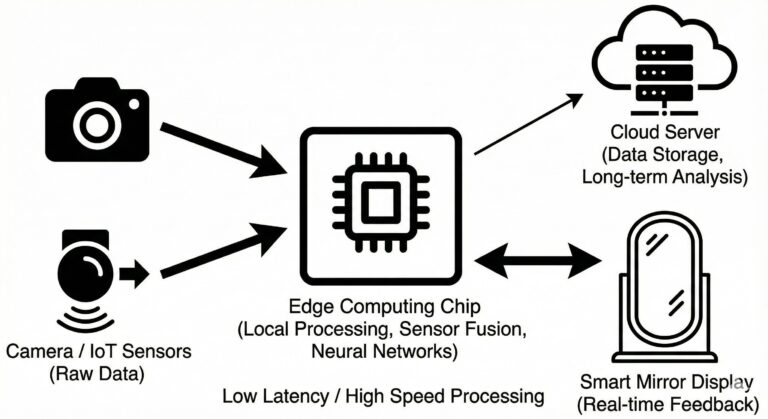 To engineer a smart mirror and its connected IoT ecosystem, the system relies on a stack of Computer Vision algorithms, specifically Pose Estimation models (like Convolutional Neural Networks), which map the user’s skeletal joints in real-time to overlay Augmented Reality (AR) form guides on the glass. This visual data is synchronized with the IoT hardware using Sensor Fusion algorithms, most notably Kalman Filters, which mathematically “scrub” the noisy raw data from the accelerometer and gyroscope to create a smooth motion curve. To ensure there is no lag between your movement and the reflection, the system utilizes Edge Computing, processing these heavy Neural Networks locally on the device’s chipset rather than in the cloud, before transmitting the finalized performance metrics via lightweight MQTT messaging protocols.
The tangible proof of improvement is evident in engagement and retention rates compared to traditional gym memberships. While nearly 50% of traditional gym members quit within six months, smart fitness devices boast retention rates upwards of 90% annually due to the community aspect and live feedback. Users report completing more workouts per week because the barrier to entry (travel time to gym) is removed, and the “gamified” form scores provide immediate, tangible evidence that their technique is improving over time.

Comments :