



How to View the Blood Moon Total Lunar Eclipse on March 3
A rare celestial event is headed our way: a total lunar eclipse, popularly known as a blood moon, will occur on March 3. During this spectacular phenomenon, the Moon passes completely into Earth’s shadow, and as sunlight refracts through Earth’s atmosphere, it gives the Moon a reddish hue — earning the nickname blood moon.
This event is not only beautiful but also an excellent opportunity for skywatchers of all levels to observe one of nature’s most striking astronomical occurrences. Here’s how you can best view it.
What Is a Blood Moon?
A total lunar eclipse happens when the Earth comes directly between the Sun and the Moon, blocking direct sunlight from reaching the lunar surface. Instead of going dark, the Moon often turns red because light from the Sun bends through Earth’s atmosphere and reaches the Moon indirectly.
Earth’s atmosphere scatters shorter blue wavelengths of light and allows longer red wavelengths to pass through — similar to what happens during a sunset. This refracted reddish light casts a warm, coppery glow on the Moon, creating the blood moon effect.
When and Where to Watch
The March 3 total lunar eclipse will be visible from much of Asia, Australia, the Pacific, and the Americas. Observers in these regions should be able to catch all or part of the eclipse, weather permitting.
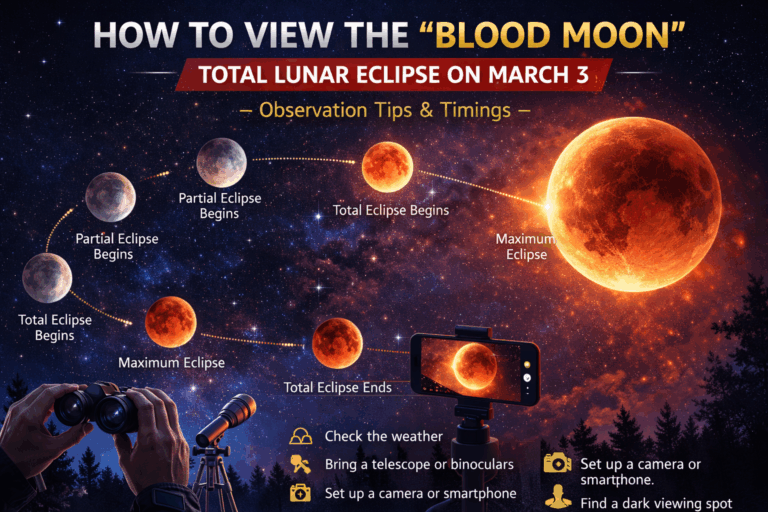
The exact timing of the eclipse phases (partial and total) varies by location, but here are general highlights:
-
Partial eclipse begins — The Moon starts entering Earth’s shadow.
-
Total eclipse begins — The Moon is fully in Earth’s shadow and appears reddish.
-
Maximum eclipse — The deepest red phase.
-
Total eclipse ends — The Moon begins emerging from Earth’s shadow.
-
Partial eclipse ends — The Moon fully exits Earth’s shadow.
Local astronomy clubs and observatories often publish detailed timing for specific cities, so consult local sources for exact start and end times in your area.
What You Need to Observe It
One of the great advantages of a lunar eclipse is that you don’t need any special equipment to enjoy it. The blood moon is bright enough to be seen with the naked eye.
However, for a more detailed view:
-
Binoculars will help enhance the Moon’s surface features.
-
A small telescope can offer an even better look at the color changes and lunar details.
-
Smartphone cameras can capture the event, especially with modern zoom and low-light features.
No protective eyewear is required for lunar eclipses — unlike solar eclipses — because you’re viewing reflected sunlight rather than looking directly toward the Sun.
Tips for Better Viewing
Here are some tips to make the most of your eclipse viewing experience:
-
Check the weather forecast: Clear skies significantly improve visibility.
-
Choose a dark location: Avoid bright city lights if possible.
-
Arrive early: Watch the transition from partial to total eclipse.
-
Bring a camera or tripod: It helps capture sharper images during low light.
Why It’s Worth Watching
Lunar eclipses are relatively rare and offer a dramatic reminder of celestial mechanics in action. Unlike solar eclipses, they are safe to observe without eye protection and can be enjoyed by families, students, and amateur astronomers alike.
Whether you’re a seasoned skywatcher or seeing an eclipse for the first time, the blood moon of March 3 promises a memorable night under the stars.
Source: https://www.wired.com/story/how-to-view-the-blood-moon-total-lunar-eclipse-on-march-3/
Comments :