


CERBERUS, Computer Engieering BINUS Very Own
The Multi-Headed Beast of BINUS Computer Engineering
https://www.instagram.com/p/DT-KTgMk6Sl/
JAKARTA — In ancient Greek mythology, Cerberus was the terrifying, multi-headed hound that guarded the gates of the underworld, seeing all and letting nothing escape its watch. At the Synthesis 2026 exhibition, that ancient myth was forged into modern metal and silicon.
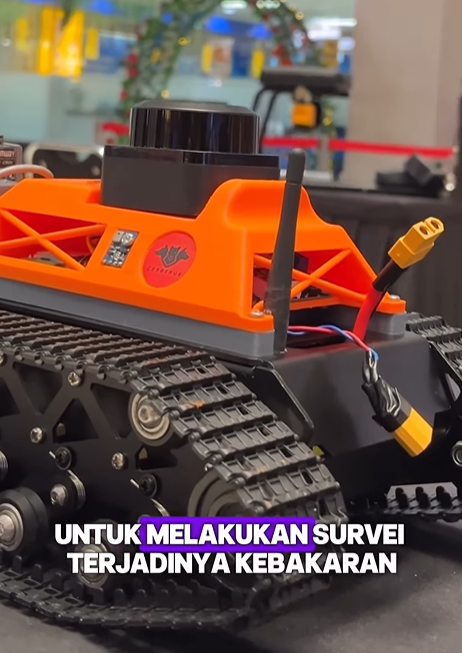
Meet CERBERUS—a remote-operated, environment-mapping tank engineered from the ground up by the brilliant minds at BINUS Computer Engineering.
While the ASU-standard workspace and international collaborations set the global stage at Synthesis, CERBERUS stole the show by demonstrating exactly what our students can build when raw engineering talent meets cutting-edge technology. It is not just a robot; it is a multi-headed sensory powerhouse designed to conquer and map the unknown.
⚙️ The Anatomy of a Mechanical Myth
To understand how CERBERUS “sees” and maps its environment, you have to look under the hood at its meticulously integrated hardware and software stack. This robot doesn’t just drive; it calculates its world in real-time.
-
The Brains (ROS & Raspberry Pi): The core intelligence of CERBERUS runs on a Raspberry Pi, which is powered by ROS (Robot Operating System). ROS is the industry standard for robotics, acting as the central nervous system that processes complex mapping algorithms and manages communication between all the different “heads” of the beast.
-
The Nerves (ESP32): While the Pi handles the heavy lifting, an integrated ESP32 microcontroller handles the lightning-fast, low-level reflexes. It translates the commands from the brain into precise electrical signals to drive the tank treads and control the servos with zero latency.
-
The Eyes (LiDAR & Servo-Camera): This is where the mapping magic happens. CERBERUS is equipped with a spinning LiDAR (Light Detection and Ranging) sensor that fires thousands of laser pulses a second to measure the exact distance to surrounding objects, creating a highly accurate 2D/3D digital map (a point cloud) of the room. Paired with this is a high-definition camera mounted on a dynamic servo motor, allowing the robot to pan and tilt its “head” to visually inspect areas of interest.
-
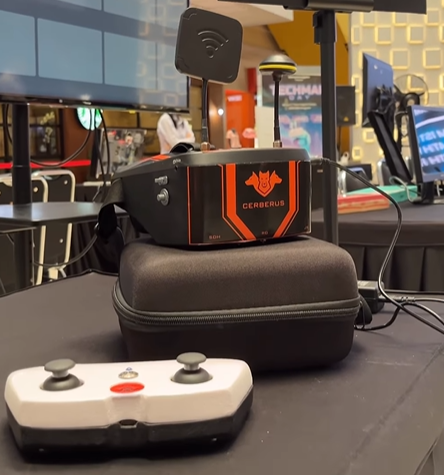
The Telepathic Link (AR Goggles & Radio): What makes CERBERUS truly feel like sci-fi is how you control it. Instead of a boring joystick and monitor, the LiDAR mapping data and live camera feed are beamed over a high-frequency radio link directly into AR (Augmented Reality) Goggles worn by the operator. You don’t just drive CERBERUS; you see what it sees, fully immersed in the environment it is mapping, even from a safe distance.
🏛️ Guarding the Future
CERBERUS is a glaring, tread-grinding statement: BINUS Computer Engineering students are not just participating in the tech industry; they are building the sentinels of the future. By fusing the relentless, all-seeing nature of its mythological namesake with the apex of modern robotics (SLAM mapping, ROS, and AR teleoperation), our students have created a flagship product that proves their capability to innovate on a world-class level.
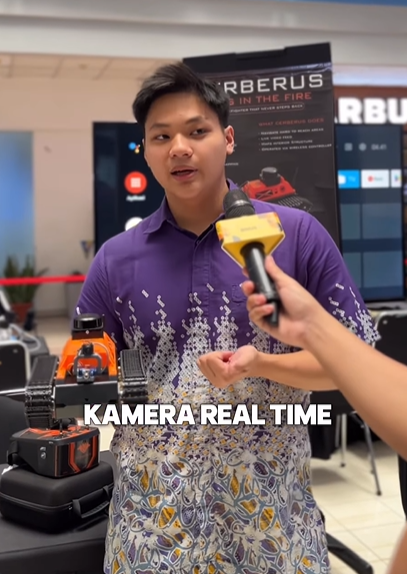
The gates of the future are open, and CERBERUS is leading the charge. Follow the beast’s journey across @io.binus, @computerengineeringbinus!
Comments :