



Using Physics to Escape an Ice Bowl: Understanding the Science Behind a Viral Challenge
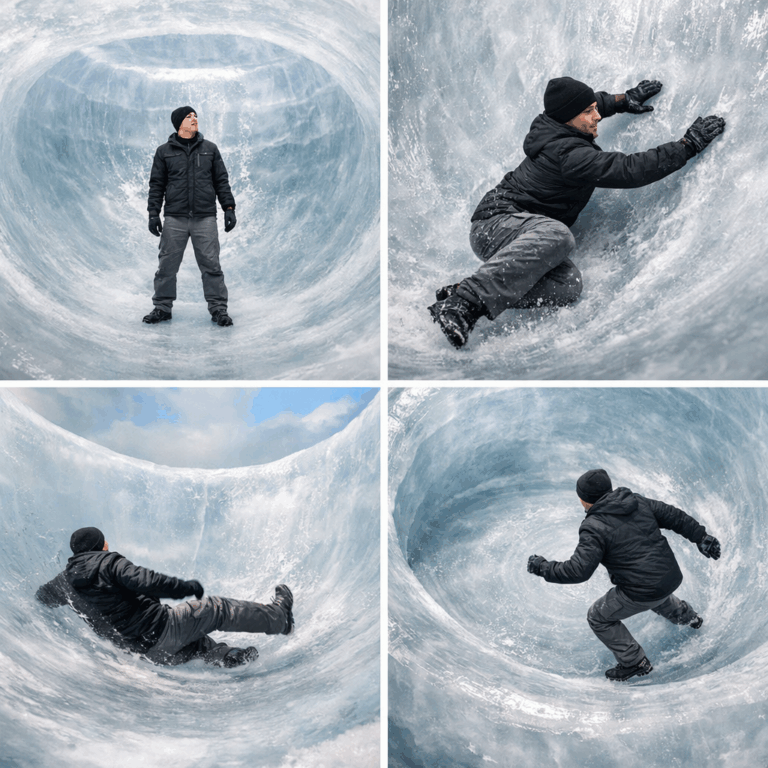
A popular viral challenge involves placing someone inside a bowl carved from ice and seeing whether they can escape. Although it may seem like a simple physical challenge, it actually demonstrates several important principles of physics, particularly friction, motion, and force. By applying these scientific concepts, escaping an ice bowl becomes not only possible but also predictable.
Why Escaping an Ice Bowl Is Difficult
An ice bowl is shaped like the inside of a sphere, meaning the surface becomes steeper as you move upward. The slippery nature of ice creates an additional challenge because it significantly reduces friction between your shoes and the surface.
Friction plays a critical role in walking or climbing. Normally, when a person walks, they push backward against the ground, and friction pushes them forward. The amount of friction depends on two main factors: the material surfaces in contact and the normal force, which is the force pushing two surfaces together.
Ice has an extremely low friction coefficient compared to surfaces such as asphalt. As a result, people tend to slip easily because there is insufficient friction to support stable movement. Additionally, as the slope becomes steeper, the normal force decreases, which further reduces friction and makes climbing nearly impossible.
Three Physics-Based Strategies to Escape
Researchers and science educators have proposed several methods for escaping an ice bowl using basic physics principles.
1. Enter With Momentum
One strategy involves approaching the ice bowl with speed rather than slowly stepping into it. By maintaining momentum, a person can slide down and continue moving upward along the opposite side before losing energy. This approach prevents becoming trapped at the bottom where movement is more difficult.
2. Build Energy by Moving Back and Forth
Another method involves walking back and forth across the relatively flat center of the bowl. Even though friction is limited, repeated movement allows the person to gradually gain speed and climb higher along the sides. Over time, the accumulated energy may allow them to reach the edge and escape.
3. Escape Using Circular Motion
The third strategy uses circular or spiral movement. When a person walks in a circular path, they experience centripetal acceleration, which increases the normal force pressing them against the surface. Since friction is proportional to the normal force, increasing this force improves traction. By gradually widening the circular path, a person can climb higher until reaching the rim of the bowl.
The Physics Principles Behind the Challenge
The ice bowl scenario highlights several fundamental physics concepts:
-
Newton’s Second Law: Motion requires force, and acceleration depends on applied force and mass.
-
Newton’s Third Law: When a person pushes against the ground, the ground pushes back, enabling movement.
-
Frictional Forces: Friction depends on both surface materials and normal force.
-
Circular Motion: Moving in a circular path can increase traction through additional forces.
Together, these principles explain why escaping an ice bowl is difficult and how physics can provide practical solutions.
Learning Physics Through Real-World Scenarios
The ice bowl challenge demonstrates how scientific principles apply to everyday situations. It shows that understanding physics is not only useful for academic learning but can also help solve practical physical challenges. By studying forces, friction, and motion, people can better understand how objects and bodies interact with their environment.
Source: https://www.wired.com/story/how-to-use-physics-to-escape-an-ice-bowl/
Comments :