


Implementation of BINUS PusGita in Fakfak, West Papua
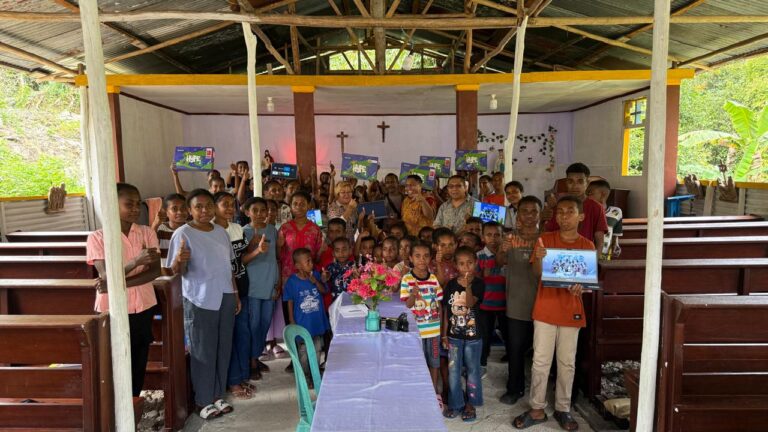
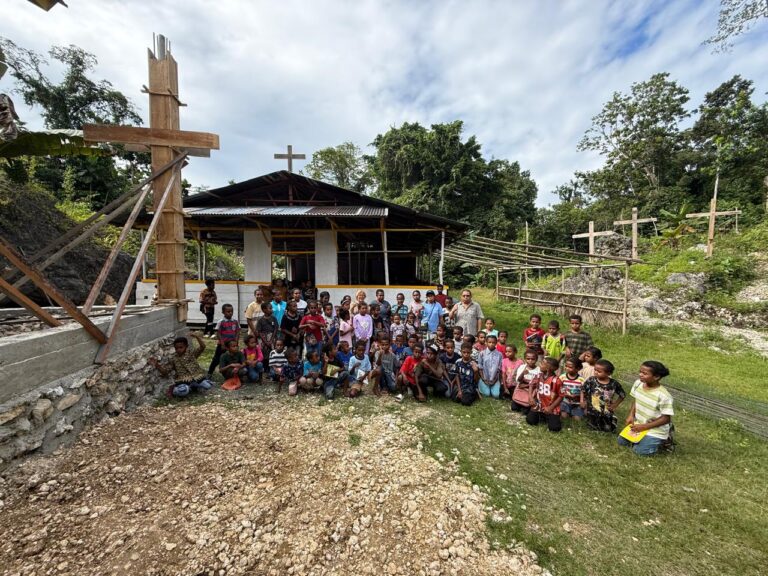
Fig. 1: PusGita at Kampung Sipatnanam. A full classroom of children holding up laptops and cards, smiling at the camera.
There is a particular kind of quiet you only find in the districts of Fakfak. The roads thin out, the phone bars disappear one by one, and eventually you reach places where “just look it up online” is not a sentence that means anything. For the children who grow up here, the world’s largest library — the internet — might as well be on another planet. So in early June 2026, a small team from BINUS University carried the library to them instead.
A library you can hold in two hands
The program is called PusGita, short for an offline digital library, and the idea behind it is almost stubbornly simple: if children can’t reach the internet, build them a library that doesn’t need one.
At the heart of PusGita sits a Raspberry Pi — a computer not much bigger than a deck of cards — loaded with roughly 7,000 pieces of content: educational videos, e-books, and interactive learning material. Pair it with a laptop, give it a power source that keeps working when the electricity doesn’t, and you have a complete library that runs on a table in a village hall, with no signal required. It’s the kind of technology that asks for very little and gives back a great deal.
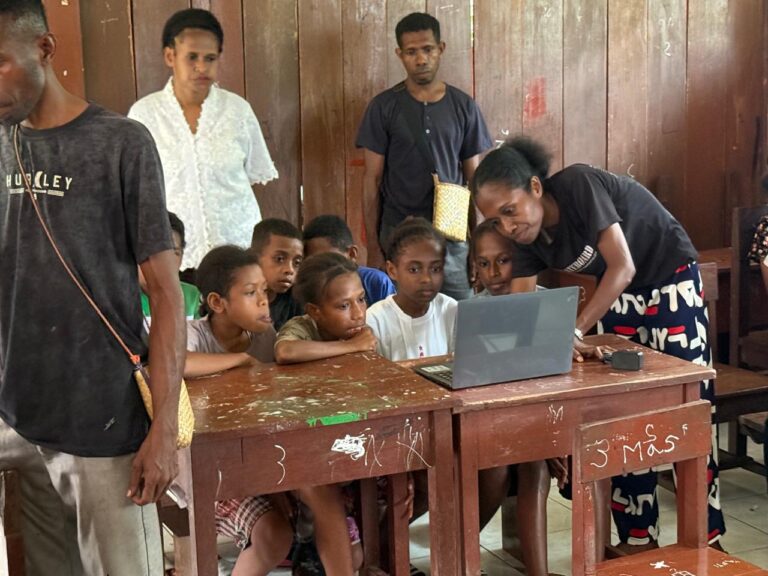
Fig. 2: PusGita at Kampung Us Adora. Children crowded around a laptop, one of the team members showing them the interface.
Six days, five communities
Between June 1 and 6, the team — Rinda Hedwig, Francis B. Santoso, Marcel Saputra, Olifia Rombot, and John R. Hartono — traveled across five districts of Fakfak: Pariwari, Furwagi, Teluk Patipi, Kramomongga, and Fakfak Timur Tengah. Each stop followed the same gentle rhythm. Set up the device. Explain how it works. Then step back and watch. That last part was the easy bit. Children don’t need much convincing to open a screen full of stories. What started as polite curiosity in the first few minutes usually turned into the happy, slightly chaotic noise of more than a hundred kids discovering they could read, watch, and explore whatever caught their eye — at their own pace, in their own time.
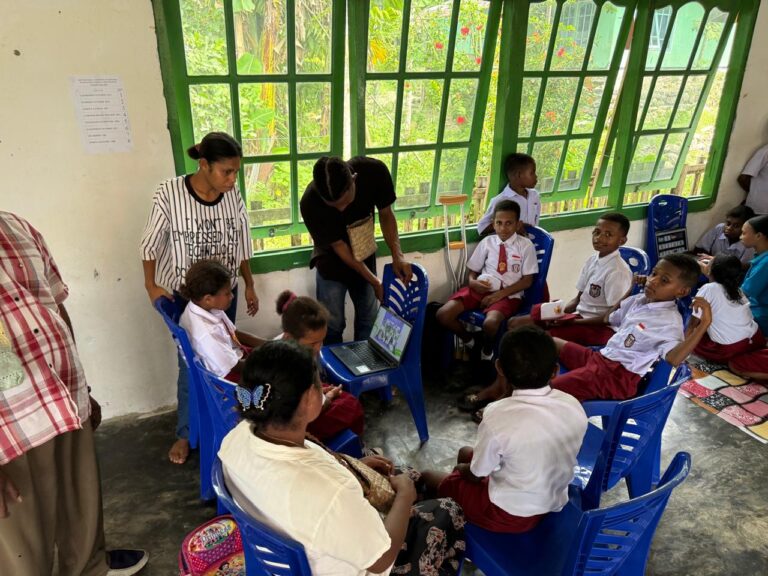
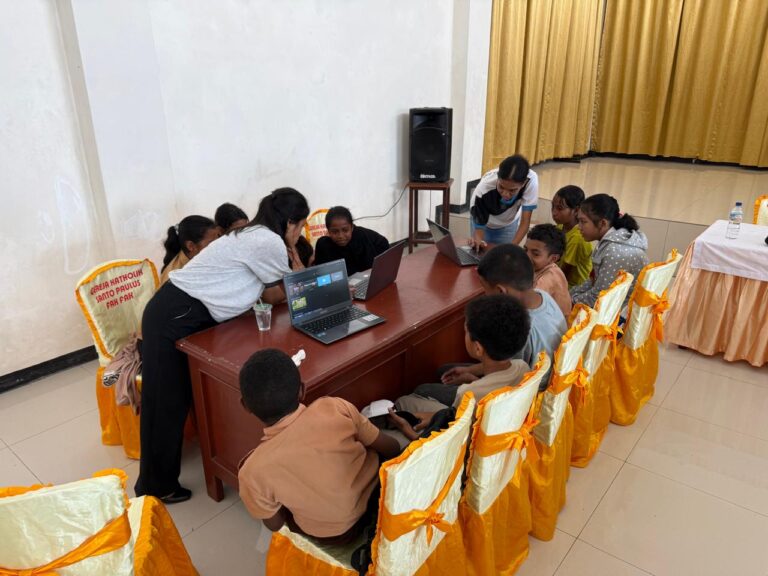
Fig. 3: PusGita at Kampung Mamor. A village hall full of children gathered around the screens.
More than a one-day visit
It would be easy for a program like this to be a nice afternoon and nothing more — a team arrives, takes a few photos, and leaves the technology behind to gather dust.
The team designed PusGita to avoid exactly that. Alongside the children, they spent time with teachers and local facilitators, walking them through how to run the system and keep it useful long after the visitors had flown home. The devices were formally handed over to the community through Paroki Santo Paulus in Wagom, with a clear understanding: this belongs to you now, for learning, for as long as you need it. A library only matters if it stays open. This one was built to.
Why it matters
There’s a tendency to talk about education gaps in big, abstract numbers. But in Fakfak the gap is concrete: it’s a child with every bit of the curiosity and capacity of a child anywhere, and almost none of the access.
PusGita doesn’t fix everything. It doesn’t pave roads or string fiber-optic cable through the hills. What it does is smaller and, in its own way, quietly radical — it puts thousands of stories and lessons into the hands of children who had no practical way of reaching them before, and it does so on their terms, offline, where they live.
That’s the part worth holding onto. This work sits squarely within the global push for Quality Education (SDG 4) and Reduced Inequalities (SDG 10) — but you don’t need the framework to understand it. You just need to see a child lean toward a screen, find something they like, and keep going on their own.
BINUS PusGita — Offline Digital Library. Implemented in Fakfak, West Papua, June 2026, in partnership with Paroki Santo Paulus, Wagom.
Comments :