



The Jabulani vs New Kid on the Block, Trionda : The World Cup’s Newest Football Design
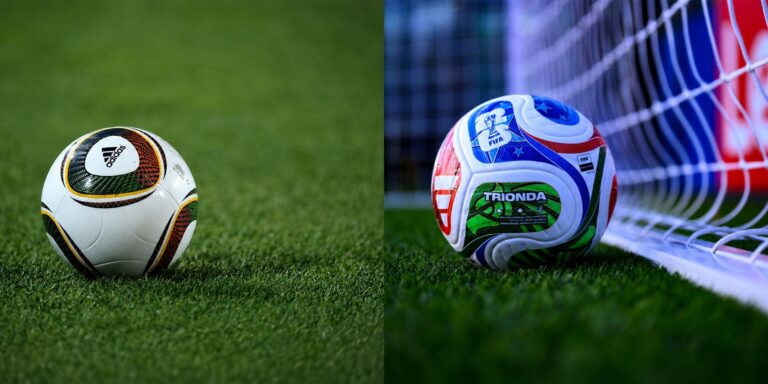 The adidas TRIONDA, official match ball of the FIFA World Cup 2026, is more than a redesigned football. It combines aerodynamic engineering, surface optimisation and high-frequency sensing to create a ball that can assist referees while also measuring how the game is played. Its most important advancement is not simply that it contains a sensor—connected-ball technology already appeared at the 2022 World Cup—but that the physical ball, sensing system and FIFA’s match-data infrastructure now operate as a more integrated measurement platform.
A sensor recording 500 times per second
Inside TRIONDA is a motion sensor operating at 500 Hz. This means it records the ball’s movement 500 times every second, producing a new measurement approximately every two milliseconds.
The sensor captures acceleration and small movements along three dimensions. From these measurements, FIFA’s systems can calculate information such as:
- The precise moment the ball is kicked
- Changes in direction and acceleration
- Ball velocity
- The distance travelled by a shot
- Possible player touches or deflections
- The movement profile of a pass or strike
This explains how FIFA can publish connected-ball leaderboards such as the fastest goals and longest-distance strikes. In the article provided, Senegal’s Idrissa Gueye leads the maximum-speed ranking, while Cabo Verde’s Kevin Pina leads the distance ranking for his goal against Uruguay. These measurements come from the ball itself rather than being estimated entirely from broadcast footage.
A normal television camera may record 50 or 60 frames per second. At 500 measurements per second, the connected ball provides much finer timing information, especially during the extremely brief moment when a player’s boot contacts the ball.
Improving offside decisions
One of the sensor’s most important roles is assisting the video assistant referee, particularly during offside reviews.
An offside decision requires officials to determine two things:
- Where the attacking and defending players were positioned.
- The exact instant a teammate played the ball.
Stadium tracking cameras can determine the positions of the players, but identifying the precise kick point from video can be difficult. A player’s foot may remain in contact with the ball for several frames, making it unclear which frame should be used.
TRIONDA’s sensor detects the sudden acceleration created by contact. Its data can then be synchronised with optical player tracking, helping the semi-automated offside system select the relevant moment more accurately. The system sends this information to the VAR team in real time; it supports the officials rather than making the final decision independently.
According to FIFA, connected-ball data can also help identify subtle touches and changes in direction that may be difficult to confirm from camera footage alone. FIFA’s connected-ball technology overview
The principal aerodynamic difference
The main difference is not simply that TRIONDA has fewer panels. In fact, reducing the panel count can make aerodynamic control more difficult because it also reduces the number and total distribution of seams.
Jabulani tried to solve this by producing an exceptionally round, relatively smooth ball. The problem was that a football actually needs carefully distributed surface roughness. This roughness controls the thin layer of air flowing around the ball.
With Jabulani, the seams were comparatively shallow and less evenly distributed. When the ball travelled with little spin, airflow could separate differently from one side to another. This produced changing sideways forces, resulting in the famous Jabulani “knuckle” movement.
NASA reported that Jabulani experienced its strongest knuckling around 50 mph or approximately 80 km/h—a speed frequently reached by shots and free kicks. That placed its unstable aerodynamic region directly inside normal match conditions. NASA’s aerodynamic explanation
TRIONDA follows a different philosophy. Although it has only four panels, its seams are deliberately deeper. FIFA says these seams generate sufficient and more evenly distributed drag, with the intention of producing more stable flight. FIFA’s official TRIONDA announcement
| Lesson from Jabulani | TRIONDA’s response |
|---|---|
| A smoother ball is not necessarily more predictable | TRIONDA deliberately uses deeper seams and surface texture |
| Reducing panel count changes airflow significantly | The four-panel geometry was designed together with its seam arrangement |
| Uneven surface roughness can produce asymmetric forces | Drag is intended to be distributed more evenly around TRIONDA |
| Laboratory roundness does not guarantee stable match behaviour | TRIONDA prioritises controlled airflow as well as spherical consistency |
| A ball was previously isolated from officiating systems | TRIONDA contains a sensor connected to VAR and match-data systems |
Comments :