



Five Real Technologies Behind The Odyssey
Christopher Nolan’s 2026 adaptation of The Odyssey presents a world filled with gods, monsters and supernatural dangers. However, underneath its fantasy elements, the story also contains technologies that were scientifically possible during the ancient Greek world. The Trojan War is traditionally associated with the Late Bronze Age, around 1200 BCE, while Homer’s Odyssey was composed several centuries later. The technologies in the story therefore combine Bronze Age practices, Homeric traditions and details added by later Greek and Roman writers.
1. Wooden Rollers for the Trojan Horse
One of the most interesting engineering methods shown in the story is the use of wooden rollers to transport the Trojan Horse. Homer mentions the wooden horse and the warriors hidden inside it, but the roller mechanism is described more clearly by the later poet Quintus of Smyrna. In The Fall of Troy, Epeius places smooth wooden rollers beneath the horse so that the Trojans can pull it into their city using ropes. The rollers reduced resistance by replacing sliding friction with rolling motion. Workers would pull the horse forward while others collected each roller emerging from the back and returned it to the front. This effectively created a reusable track beneath the horse. Long ropes allowed many people to combine their strength, while side ropes helped control its direction.
The method was realistic, although difficult on sand, mud or steep terrain. Wooden planks may have been placed beneath the rollers to stop them sinking, while levers and wedges could lift, realign or prevent the horse from rolling backward. The same basic technique was used to launch ships and transport other heavy wooden structures.
2. Timber Construction and Ancient Carpentry
A Trojan Horse large enough to hide soldiers could not have been made from solid wood because it would have been extremely heavy. A more realistic design would use an internal timber skeleton covered with thinner wooden planks, similar to the construction of an ancient ship’s hull. Bronze Age carpenters possessed axes, adzes, chisels, drills and saws. They could connect beams using mortise-and-tenon joints, wooden pegs, rope lashings and animal-hide bindings. Cross-bracing would strengthen the structure and prevent it from twisting or collapsing while being pulled across uneven ground.
The horse would also require an internal platform, ventilation and a concealed entrance. Although no archaeological evidence proves that the Trojan Horse existed, ancient shipbuilders possessed enough technical knowledge to construct a large hollow wooden structure. Its successful use would have depended as much on careful engineering as on convincing the Trojans to accept it.
3. Bronze Weapons and Metallurgy
Bronze was one of the most important materials in the world represented by The Odyssey. It was normally produced by combining copper with tin, creating an alloy that was generally stronger and more useful for weapons and tools than pure copper. Craftsmen melted the metals in furnaces, poured the bronze into moulds and then hammered, sharpened and polished the finished object. This process produced swords, spearheads, axes, helmets, armour fittings, shield reinforcements, woodworking tools and cooking vessels. Damaged objects could also be melted and recycled.
Bronze production required specialised workers and long-distance trade because copper and tin were rarely found together. Consequently, every bronze sword or tool represented a network of miners, merchants, sailors and metalworkers. Bronze technology was therefore not only important for warfare but also for trade and political power.

4. Ships Powered by Sails and Oars
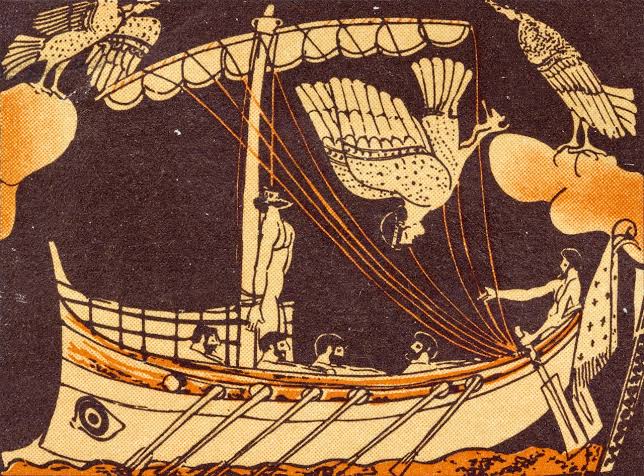
Ships made the Trojan expedition and Odysseus’s journey possible. Ancient Greek vessels were constructed from timber planks connected to an internal frame using wooden joints, pegs and rope. Pitch or similar materials could be applied to reduce water leakage. A square sail provided power when the wind was favourable, while rows of oars allowed the crew to move when the wind was weak or travelling in the wrong direction. Large steering oars near the rear controlled the vessel because these ships did not possess a modern central rudder.
Ships could also be pulled onto beaches for protection or repairs. Wooden rollers, ropes and collective labour could help move them between the land and sea—the same mechanical principle used for the Trojan Horse. Although effective, these vessels remained vulnerable to storms, strong currents and shortages of drinking water.
5. Navigation Using Stars and Landmarks
Odysseus did not have a magnetic compass, accurate map or satellite navigation. Ancient sailors instead relied on practical astronomy and careful observation of the natural environment to determine their direction. At night, they followed stars and constellations such as the Bear, associated with Ursa Major. During the day, sailors observed the Sun, coastlines, mountains, winds, currents, wave direction, birds, water depth and cloud formations. This knowledge was passed orally between generations of experienced navigators.
Most voyages followed coastlines because visible landmarks made navigation safer. Sailors could also stop at beaches to collect food and fresh water. However, storms could push a vessel away from familiar routes, which may explain why the Odyssey portrays the sea as an unpredictable world controlled by gods and inhabited by monsters.
Science Inside the Myth
The supernatural events of The Odyssey belong to mythology, but many of its human technologies were practical and achievable. Ancient people understood woodworking, metallurgy, shipbuilding, navigation and the mechanical advantages provided by rollers, ropes and levers. The Trojan Horse is the strongest example of science existing inside the legend. Its historical existence remains uncertain, but constructing and moving it would have been technically possible. Ultimately, its effectiveness depended on two technologies working together: physical engineering allowed the horse to move, while psychological deception persuaded the Trojans to bring it inside themselves. Though in all shapes and sizes, maybe the irony is the how those technology inspired and actually made the whole movie business a shot of something amazing and beautiful.
Comments :