



Leaded vs. Lead-Free Solder (Tin): What’s the Difference and Why Does It Matter?
Standing in the Aisle: Why Are There So Many Types of “Tin”?
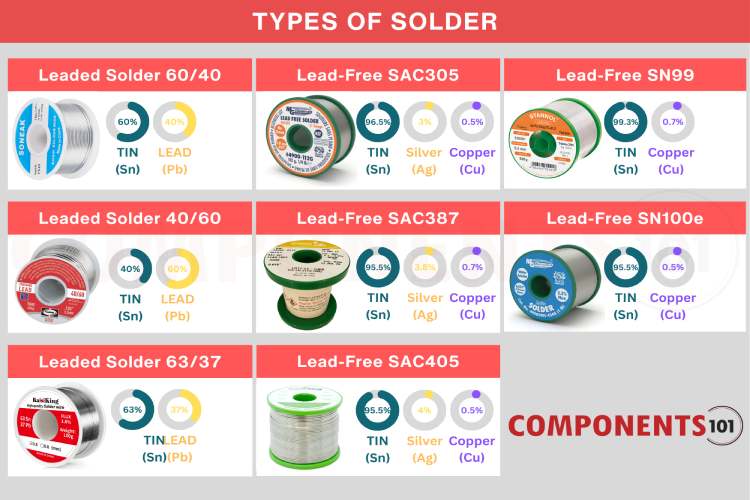
Type of Solder Tin, https://components101.com/article/different-types-of-solders-tin-solder-lead-solder-flux-core-solder-and-rosin-core-solder
Whether you are repairing a frayed headphone cable, assembling an Arduino or ESP32 sensor board, swapping a motor connector on an RC drone, or fixing a broken power jack on a household gadget, solder wire—often casually referred to simply as “tin”—is the metallic glue that holds modern electronics together. Without it, components would fall off circuit boards and electrical signals would never reliably pass from wire to copper pad.
Yet the moment you walk into an electronics supply shop or browse an online marketplace to buy a fresh roll of solder, a confusing wall of technical codes greets you. One spool reads 60/40, another says 63/37, and a bright green spool right next to it advertises Sn99.3/Cu0.7 or SAC305 (Pb-Free) at nearly twice the price. They all look like shiny silver wire wound onto a plastic reel—so what do these numbers actually mean, and does the choice really change how your project turns out?
Those codes tell you the exact metal alloy recipe inside the wire—specifically, how much tin (Sn) is blended with lead (Pb) or lead-free alternatives like copper (Cu) and silver (Ag) (IPC, 2020). Let’s decode two of the most common spools you will encounter on the shelf:
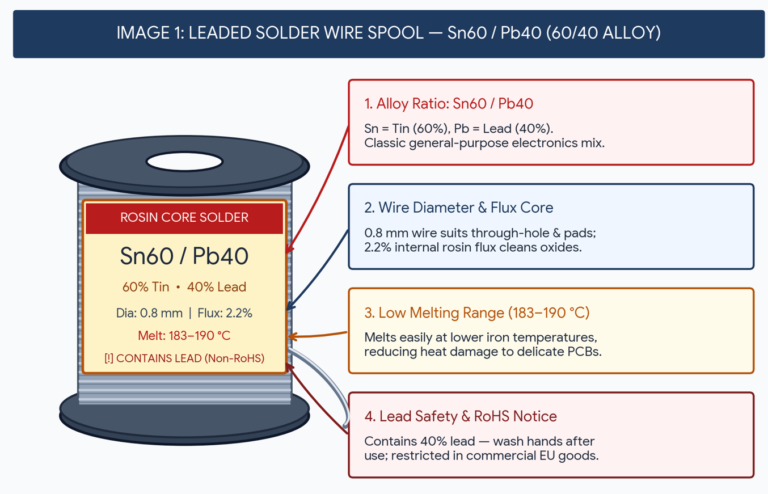
| Picture Above (Leaded Solder Spool — Sn60/Pb40): Decoding the label: Sn60/Pb40 stands for 60% Tin (chemical symbol Sn) and 40% Lead (chemical symbol Pb). “0.8 mm” is the wire diameter, “Flux 2.2%” indicates the internal rosin core that cleans metal oxides while heating, and “183–190 °C” is its low melting range (Kester, 2018). |
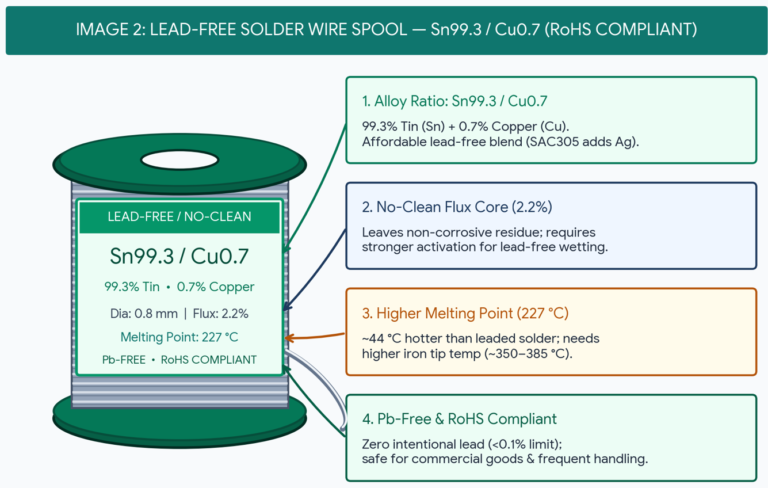
| Picture Above (Lead-Free Solder Spool — Sn99.3/Cu0.7): Decoding the label: Sn99.3/Cu0.7 means 99.3% Tin alloyed with 0.7% Copper (Cu) and zero intentional lead. Notice the higher 227 °C melting point and the “Pb-Free / RoHS Compliant” marking indicating compliance with hazardous-substance regulations (European Parliament and Council, 2011). |
What Is the Difference Between Leaded and Lead-Free Solder?
Pure tin melts at 232 °C (450 °F), which is relatively hot for delicate electronic parts. Engineers mix tin with other metals to create alloys that melt at lower temperatures, flow more smoothly, and form stronger mechanical bonds (TWI Global, n.d.). The dividing line between the two main solder families comes down to what is mixed with the tin.
Alloy Composition
- Leaded Solder (Tin + Lead): Traditional electronics solder blends tin (Sn) with lead (Pb). The two most popular formulas are Sn60/Pb40 (60% tin, 40% lead) and Sn63/Pb37 (63% tin, 37% lead). Adding lead dramatically lowers the melting temperature and reduces surface tension (Kester, 2018).
- Lead-Free Solder (Tin + Copper, Silver, or Bismuth): To eliminate lead, manufacturers blend high percentages of tin (typically 96% to 99.3%) with small amounts of copper (Cu), silver (Ag), and occasionally bismuth (Bi) or nickel (Ni). Common varieties include budget-friendly 3/Cu0.7 and industry-standard SAC305 (Sn96.5/Ag3.0/Cu0.5 — 96.5% tin, 3.0% silver, 0.5% copper) (IPC, 2020; Indium Corporation, 2020).
Melting Temperature, Wetting Flow, and Ease of Use
Changing the metal recipe changes how the solder behaves under your soldering iron tip:
- Melting Temperature: Eutectic Sn63/Pb37 melts and freezes sharply at a single temperature of 183 °C (361 °F), while Sn60/Pb40 softens across a narrow 183–190 °C (361–374 °F) range (Kester, 2018). By contrast, SAC305 melts at 217–220 °C (423–428 °F) and 3/Cu0.7 requires 227 °C (441 °F)—roughly 35 °C to 44 °C hotter (Indium Corporation, 2020). Because of this higher melting point, soldering iron tips are typically set around 315–350 °C for leaded solder versus 350–385 °C for lead-free solder.
- Wetting and Flow Behavior: “Wetting” describes how smoothly molten solder spreads across a clean copper pad and climbs up a component lead. Leaded solder has lower surface tension, so it flows like warm honey and self-aligns components effortlessly. Lead-free solder has higher surface tension and higher viscosity—meaning it moves more sluggishly and relies heavily on active flux to spread evenly across a pad (IPC, 2020).
- Ease of Working with the Iron: Because leaded solder melts at a lower temperature and freezes instantly (especially Sn63/Pb37), you spend less time holding the hot iron on the circuit board, making it much more forgiving for beginners.
Side-by-Side Comparison: Leaded vs. Lead-Free Solder
| Property / Feature | Leaded Solder (e.g., Sn63/Pb37, Sn60/Pb40) | Lead-Free Solder (e.g., SAC305, Sn99.3/Cu0.7) |
| Typical Composition | 60–63% Tin (Sn), 37–40% Lead (Pb) | 96.5–99.3% Tin (Sn), 0.5–0.7% Copper (Cu), 0–3.0% Silver (Ag) |
| Melting Point | 183 °C (eutectic 63/37) or 183–190 °C (60/40) | 217–220 °C (SAC305) or 227 °C (Sn99.3/Cu0.7) |
| Recommended Iron Tip Temp | 315 °C – 350 °C (600 °F – 660 °F) | 350 °C – 385 °C (660 °F – 725 °F) |
| Wetting & Flow Behavior | Fast, fluid wetting; low surface tension | Slower wetting; higher surface tension; needs active flux |
| Ease of Soldering | Very easy; forgiving for beginners & rework | Moderate; requires better heat control & tip tinning |
| Finished Joint Appearance | Smooth, bright, mirror-shiny concave fillet | Dull, matte, frosted, or slightly grainy surface (normal) |
| RoHS Regulatory Status | Restricted in commercial electronics (>0.1% Pb) | Fully RoHS compliant (<0.1% Pb limit) |
| Typical Cost per Spool | Lower (widely available for hobbyists) | Higher (especially silver-bearing SAC305 alloys) |
Why Does This Difference Matter?
Choosing between leaded and lead-free solder goes beyond convenience at the workbench—it affects your personal health habits, international environmental laws, and how long your electronics survive in the real world.
Health & Safety: Lead Exposure vs. Flux Fumes
Many beginners assume the smoke curling up from a soldering iron is toxic lead vapor. In reality, metallic lead has a boiling point of 1,749 °C (3,180 °F) and produces negligible vapor at normal soldering temperatures of 315–400 °C (Occupational Safety and Health Administration [OSHA], n.d.). Understanding the real hazards keeps you properly protected:
- Lead Exposure (Handling & Residue): Lead is a cumulative neurotoxin that affects the nervous system, kidneys, and cardiovascular health (National Institute for Occupational Safety and Health [NIOSH], 2013). During hand soldering, the main risk is hand-to-mouth ingestion—touching leaded solder wire, oxidized dross, or bench debris and then eating, drinking, or rubbing your eyes without washing your hands—or inhaling dust when filing or sanding leaded joints (OSHA, n.d.).
- Flux Fumes (Present in BOTH Leaded and Lead-Free Solder): The visible white smoke rising from your iron comes from burning flux (typically pine rosin/colophony or synthetic resin). Rosin fumes release respiratory irritants such as abietic acid and aldehydes that can trigger eye irritation or occupational asthma (Health and Safety Executive [HSE], 2012; NIOSH, 2013). Because lead-free solder runs hotter and uses more chemically active fluxes, lead-free soldering often produces more irritating smoke than leaded soldering.
| 4 Essential Workbench Safety Habits: (1) Always use a desktop fume extractor with an activated carbon/HEPA filter or work near an open window with cross-ventilation; (2) wash your hands thoroughly with soap and water immediately after soldering; (3) never eat, drink, or keep snacks on your soldering bench; and (4) wipe down your silicone mat regularly to clear tiny solder splatters (OSHA, n.d.; HSE, 2012). |
Regulations & Environment: Why Commercial Products Ban Lead
Millions of tons of discarded smartphones, laptops, and appliances end up in landfills every year. When rainwater percolates through e-waste, lead can leach out of old circuit boards and contaminate groundwater and soil. To curb this environmental hazard, the European Union enacted the Restriction of Hazardous Substances (RoHS) Directive (originally Directive 2002/95/EC, recast as Directive 2011/65/EU / RoHS 2, and amended by Directive (EU) 2015/863 / RoHS 3) (European Parliament and Council, 2011).
Under RoHS rules, electrical and electronic equipment sold on the commercial market cannot contain more than 0.1% (1,000 parts per million) of lead by weight in any homogeneous material (European Parliament and Council, 2011). Similar regulations—including China RoHS, UK RoHS, and U.S. state e-waste laws—have made lead-free solder the global manufacturing standard. However, personal DIY projects and hobby repairs for your own use are legally exempt, which is why hobbyists can still buy leaded solder freely.
Durability & Reliability: Mechanical Stress and “Tin Whiskers”
From a materials-engineering standpoint, each alloy type has distinct mechanical strengths and weaknesses:
- Ductility vs. Drop Brittleness: Leaded solder (Sn63/Pb37) is softer and more ductile, meaning it flexes slightly under vibration, thermal expansion, and mechanical shock without cracking. Lead-free SAC305 is harder and resists high-temperature creep better, but it is stiffer and more prone to brittle fracture if a device is dropped hard (IPC, 2020; Indium Corporation, 2020).
- Thermal Stress on PCBs: Because lead-free soldering requires iron temperatures 35–45 °C hotter, prolonged contact can delaminate fragile copper traces (“lifted pads”) or overheat heat-sensitive electrolytic capacitors and plastic connectors.
- Tin Whiskers: In high-tin lead-free alloys (>95% tin), internal compressive stress in the metal crystal lattice can gradually push out microscopic, hair-like conductive filaments called tin whiskers over months or years (National Aeronautics and Space Administration [NASA], n.d.). On densely packed circuit boards, a tin whisker can bridge adjacent pins and cause sudden short circuits. Adding lead historically suppressed whisker growth, which is why critical aerospace, defense, and medical electronics long maintained special RoHS exemptions (NASA, n.d.; European Parliament and Council, 2011).
Which One Is Best for Your Soldering? (Practical Decision Guide)
You do not need to pledge loyalty to only one spool—most experienced makers keep both on their shelf and pick the right alloy for the job at hand.
When to Choose Leaded Solder (Sn63/Pb37 or Sn60/Pb40)
- You Are a Beginner Learning to Solder: Its lower melting point and effortless wetting help you form clean joints in 1–2 seconds without overheating parts—making it far easier to master proper technique.
- Delicate PCB Repairs & Vintage Electronics: Older circuit boards (especially brown phenolic/FR-2 boards) have weak adhesive holding the copper tracks down. Lower leaded soldering temperatures prevent pads from peeling off the board.
- Frequent Prototyping and Rework: When desoldering headers, testing breadboard adapters, or repairing personal RC drones and audio gear, leaded solder melts and wicks away cleanly with solder braid.
When to Choose Lead-Free Solder (SAC305 or Sn99.3/Cu0.7)
- Projects Handled Frequently by Bare Hands or Children: For custom game controllers, wearable electronics, musical instruments, or STEM kits built by kids, lead-free solder eliminates any risk of skin contact with exposed leaded joints.
- Commercial Products & Client Prototypes: If you plan to sell your electronics hardware or deliver boards to a commercial client, using RoHS-compliant lead-free solder avoids regulatory roadblocks later (European Parliament and Council, 2011).
- Plumbing & Potable Water Pipes (Special Warning!): Lead solder is strictly banned in drinking-water plumbing under regulations such as the U.S. Safe Drinking Water Act (U.S. Environmental Protection Agency [EPA], n.d.). However, never use plumbing solder or plumbing acid flux on electronics—plumbing flux is corrosive and will eat right through circuit board traces! Always use rosin-core or no-clean flux wire labeled specifically for electronics.
| Your Project / Use Case | Recommended Solder | Why It Fits Best |
| First soldering kit / beginner practice | Leaded (Sn63/Pb37) | Lowest melting point (183 °C); freezes instantly; easy to inspect |
| Repairing fragile PCBs or vintage gear | Leaded (Sn63/Pb37 or 60/40) | Gentle heat protects thin copper pads from lifting |
| Kids’ STEM workshops & wearables | Lead-Free (SAC305) | Zero lead exposure on exposed joints handled frequently |
| Commercial product / RoHS compliance | Lead-Free (SAC305) | Meets <0.1% Pb RoHS legal limits worldwide |
| Copper water pipes (plumbing) | Plumbing Lead-Free Wire | Legally required for potable water (keep away from PCBs!) |
The End Result: Shiny vs. Dull Solder Joints
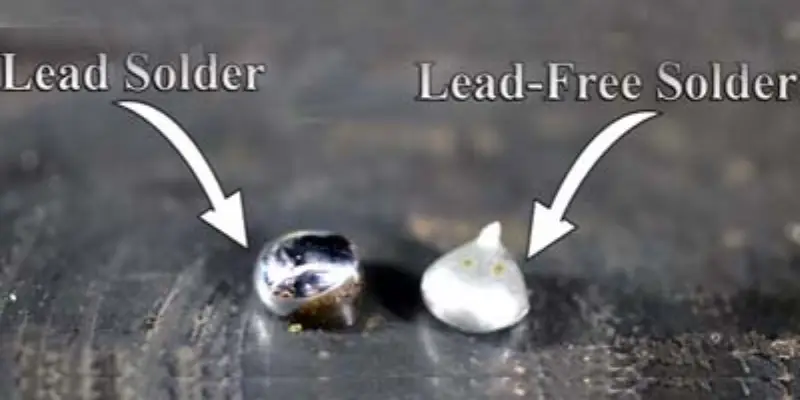
Lead vs Lead Free Solder, https://www.mokotechnology.com/lead-solder-vs-lead-free-solder/
| (Macro Visual Comparison of Finished Joints): Left (A): A healthy leaded solder joint exhibits a glossy, mirror-like concave fillet. Right (B): A healthy lead-free solder joint naturally appears matte and slightly frosted due to larger tin crystal grain structures—do not mistake this normal satin finish for a defective cold joint (IPC, 2020). |
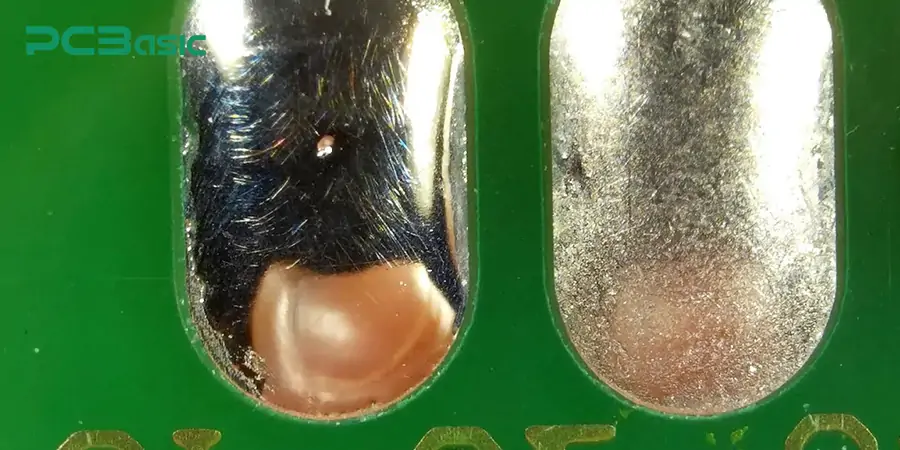
Leaded vs Lead Free, https://www.pcbasic.com/blog/lead_vs_lead-free.html
One of the biggest surprises when switching from leaded to lead-free solder happens right after you lift the iron away and inspect your work under a magnifying glass:
- Leaded Solder Cools Smooth and Mirror-Shiny: A properly heated Sn63/Pb37 or Sn60/Pb40 joint solidifies with a smooth, bright, reflective silver finish. Because leaded solder cools with a very fine microscopic grain structure, light bounces cleanly off the surface like a tiny mirror (IPC, 2020).
- Lead-Free Solder Naturally Looks Dull, Frosted, or Slightly Grainy: When SAC305 or 3/Cu0.7 cools, the high tin content forms larger dendritic crystal grains and a thin surface oxide film, giving the finished joint a matte, satin, or slightly frosty appearance (IPC, 2020; Indium Corporation, 2020).
| Beginner Trap — Don’t Reheat a Good Lead-Free Joint! Under traditional leaded soldering rules, a dull, grainy surface usually warned of a “cold solder joint” (where the metal never fully melted or moved while cooling). Beginners switching to lead-free solder often see its natural frosted texture, assume they made a cold joint, and repeatedly reheat the pad—burning the flux and lifting copper traces! Instead, per IPC-A-610 acceptability standards, judge a lead-free joint by its shape and wetting angle: if the solder forms a smooth concave slope feathered cleanly onto both the pad and component pin with no balling or gaps, it is a reliable joint (IPC, 2020). |
Bottom Line
Understanding the numbers on a solder spool takes the guesswork out of shopping for workbench supplies. Leaded solder (60/40 or 63/37) melts cooler, flows faster, and leaves bright, shiny joints—making it the top pick for beginners, delicate repairs, and personal prototypes as long as you wash your hands and ventilate flux fumes. Lead-free solder (SAC305 or Sn99.3/Cu0.7) requires slightly higher heat and cures with a matte finish, but keeps commercial products RoHS-compliant and eliminates lead from projects handled every day.
References
European Parliament and Council. (2011). Directive 2011/65/EU of the European Parliament and of the Council of 8 June 2011 on the restriction of the use of certain hazardous substances in electrical and electronic equipment (RoHS 2). Official Journal of the European Union, L 174, 88–110. https://eur-lex.europa.eu/legal-content/EN/TXT/?uri=CELEX:32011L0065
Health and Safety Executive. (2012). Controlling health risks from rosin (colophony)-based solder fluxes (INDG248). HSE Books. https://www.hse.gov.uk/pubns/indg248.htm
Indium Corporation. (2020). Lead-free solder alloy comparison guide: SAC305, SnCu, and specialty alloys (Application Note). Indium Corporation. https://www.indium.com
IPC — Association Connecting Electronics Industries. (2020). IPC J-STD-001H / IPC-A-610H: Requirements for soldered electrical and electronic assemblies & acceptability of electronic assemblies. IPC International.
Kester. (2018). Alloy temperature chart and technical data sheet: Sn63Pb37, Sn60Pb40, and SAC305 rosin-core solder wire. Illinois Tool Works (ITW). https://www.kester.com
National Aeronautics and Space Administration. (n.d.). NASA Goddard Space Flight Center tin whisker homepage: Basic information and mitigation guidance. NASA. https://nepp.nasa.gov/whisker/
National Institute for Occupational Safety and Health. (2013). Safety and health topics: Lead & soldering fume hazards. Centers for Disease Control and Prevention (CDC). https://www.cdc.gov/niosh/
Occupational Safety and Health Administration. (n.d.). Soldering and brazing safety: Lead exposure and rosin flux ventilation guidelines. U.S. Department of Labor. https://www.osha.gov
U.S. Environmental Protection Agency. (n.d.). Use of lead-free pipes, fittings, fixtures, solder, and flux for drinking water (Safe Drinking Water Act Section 1417). EPA. https://www.epa.gov/sdwa/use-lead-free-pipes-fittings-fixtures-solder-and-flux-drinking-water
Comments :