



Big Tech Says Generative AI Will Save the Planet — But It Doesn’t Offer Much Proof
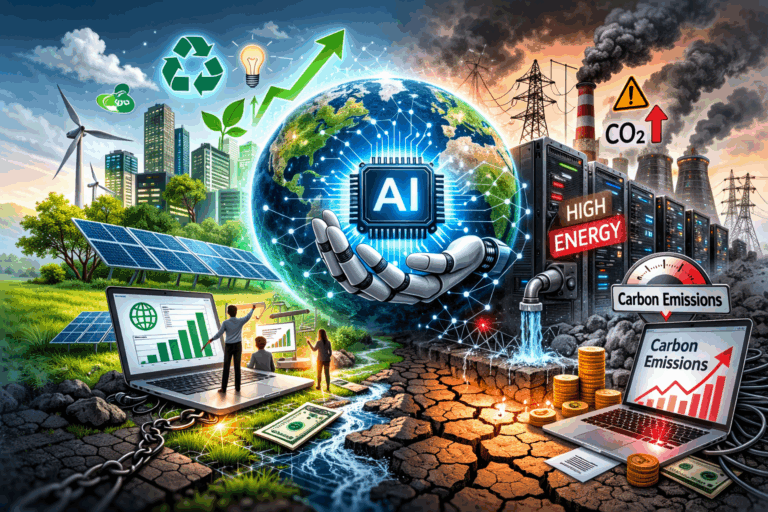
Major technology companies have increasingly promoted the idea that generative artificial intelligence (AI) can help address climate change and environmental challenges. But a growing body of analysis suggests that these claims are often poorly supported by evidence and may overlook the real environmental costs associated with AI itself.
The Report Behind the Claims
A new report examined 154 individual claims made by tech giants, energy organizations, and industry groups about how AI will benefit the climate. Of those:
-
Only about 25% were backed by academic research.
-
More than one-third cited no evidence at all to support their assertions.
Many statements touted broad environmental benefits without clear data showing how AI technologies — particularly energy-hungry generative models — would materially reduce emissions or improve sustainability in measurable ways.
Where the Promises Come From
Big tech companies such as Google and Microsoft have consistently suggested that AI can optimize energy consumption, drive decarbonization across industries, and accelerate climate solutions. At events like Climate Week, executives and advocates have highlighted AI’s power for good — from smarter grids to more efficient logistics. Tech leaders have even framed AI as a key tool in global climate strategies.
Google, for example, once estimated that AI could cut global emissions by 5–10% by 2030 — a figure widely shared in promotional materials. But critics note that these estimates were drawn from forecast models and consultancy reports rather than empirical data from real-world applications.
The Real Environmental Trade-Offs
While AI does offer potential efficiencies — such as better forecasting for renewable energy or optimized traffic flows — there’s also a growing environmental cost associated with the technology itself.
Generative AI models and large language models (LLMs) require massive amounts of computing power during training and inference. This leads to significant energy consumption and, in many regions, increased reliance on fossil fuel–powered data centers. Some research shows that data center electricity use could surge dramatically as AI deployment scales — challenging optimistic narratives about climate benefits.
AI infrastructure also demands heavy water usage for cooling and contributes to electronic waste as hardware cycles become faster to keep up with advancing models. These impacts can offset or even outweigh some claimed environmental advantages if they aren’t carefully accounted for.
Conflating Different Types of AI
One key issue identified in the analysis is that many industry claims don’t distinguish between traditional AI — such as predictive models used in weather forecasting or energy optimization — and generative AI models like ChatGPT or Google’s Gemini, which are much more energy-intensive. Critics argue that this blending of categories can inflate the perceived climate benefit of AI without acknowledging the environmental costs of today’s most powerful systems.
Experts Call for Greater Transparency
Climate researchers and technology analysts are urging more evidence-based assessments of AI’s environmental impact. They recommend clearer reporting from tech companies on:
-
How specific AI applications affect greenhouse gas emissions.
-
Whether AI sustainability claims are grounded in peer-reviewed research.
-
The lifecycle environmental costs of data center operations and AI models.
Without transparency and rigorous validation, broad claims that generative AI will “save the planet” may do more to serve marketing than to guide effective climate action.
Moving Toward Responsible AI Climate Advocacy
While AI undoubtedly has potential to support sustainability efforts — for example, in optimizing resource use or improving climate modelling — experts say the narrative should be rooted in measurable results rather than hype. As AI continues to evolve, careful evaluation of both its benefits and environmental footprint will be essential to ensure it contributes meaningfully to climate goals.
Source: https://www.wired.com/story/big-tech-says-generative-ai-will-save-the-planet-it-doesnt-offer-much-proof/
Comments :