



Virtual Reality (VR) Training: Danger can be Defined!
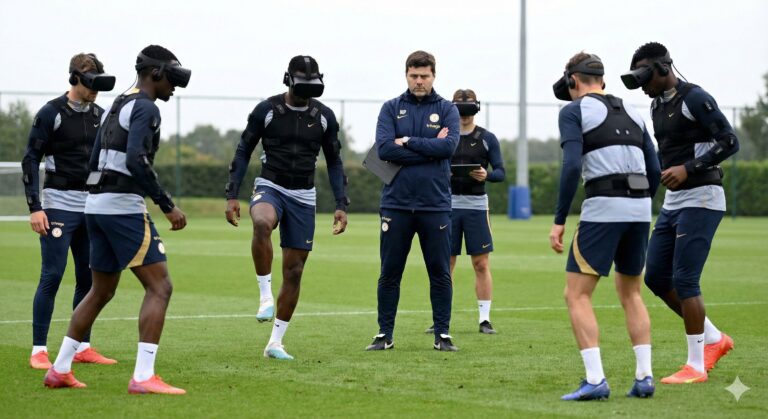
Virtual Reality (VR) training has moved from a gaming novelty to a serious cognitive training tool for professional footballers. While early experiments existed, credible VR training platforms specifically designed for football cognitive development began to be adopted by top clubs around 2016-2018. This technology focuses not on the physical body, but on the player’s brain—their decision-making, spatial awareness, and reaction time.
The main problem VR training solves is the limitation of physical training to replicate specific, high-pressure match scenarios repeatedly without causing physical fatigue or injury. You cannot ask a player to physically perform 100 corner-kick headers or face 50 one-on-one situations in a single day; their body would break down. Furthermore, it’s difficult to recreate the exact visual cues and psychological pressure of a match environment on a training pitch.
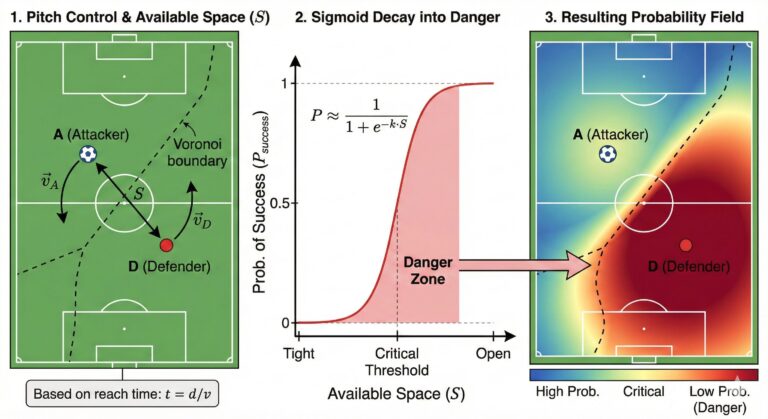 VR makes the sporting world better by providing a risk-free, highly repeatable environment for cognitive reps. Players can wear a headset and be transported onto a virtual pitch, where they can relive match situations from their own perspective, practice scanning the field before receiving a pass, or train their reaction times as a goalkeeper against virtual strikers. This allows them to train their “football brain” without putting any load on their body, which is crucial for injured players staying sharp or for getting extra tactical work in between games. The mathematical method used to analyze this relationship is Pitch Control, which combines Voronoi Tessellations with Probability Density Functions (PDFs) and Sigmoid Decay. In this model, the pitch is treated as a continuous field where every coordinate (x, y) is assigned a control probability value based on which player can reach it first (calculated using Newton’s motion equations: t = d/v). To quantify the “decay into danger,” engineers use a Logistic (Sigmoid) Function; as the radius of available space (S) shrinks between the ball carrier and the nearest defender, the probability of a successful progressive action (P_{success}) does not decrease linearly. Instead, it follows a curve ($P = 1 / (1 + e^{-k *S})) where the “danger” remains low until the space hits a critical “pressure threshold,” at which point the probability of success decays exponentially towards zero, mathematically defining the exact boundary where a tight space becomes a lost cause.
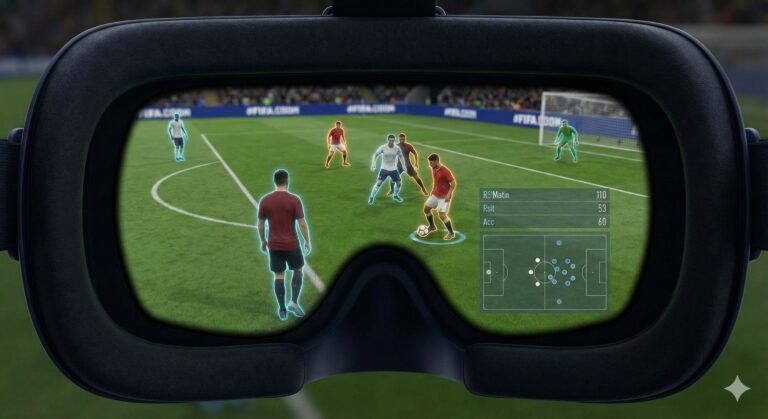 The proof of its effectiveness is in its growing adoption for specific use cases. Goalkeepers, for example, use VR to face hundreds of penalty kicks or shots, improving their cue-reading and reaction times. Data from these platforms can track improvements in “scanning frequency” (how often a player checks their surroundings) or “decision-making speed” in milliseconds. Clubs use it to accelerate the tactical learning curve for new signings by immersing them in the team’s virtual playing style before they even step on the real pitch.

Comments :