



Scaling Multimodal Robot Learning with NVIDIA Isaac Lab
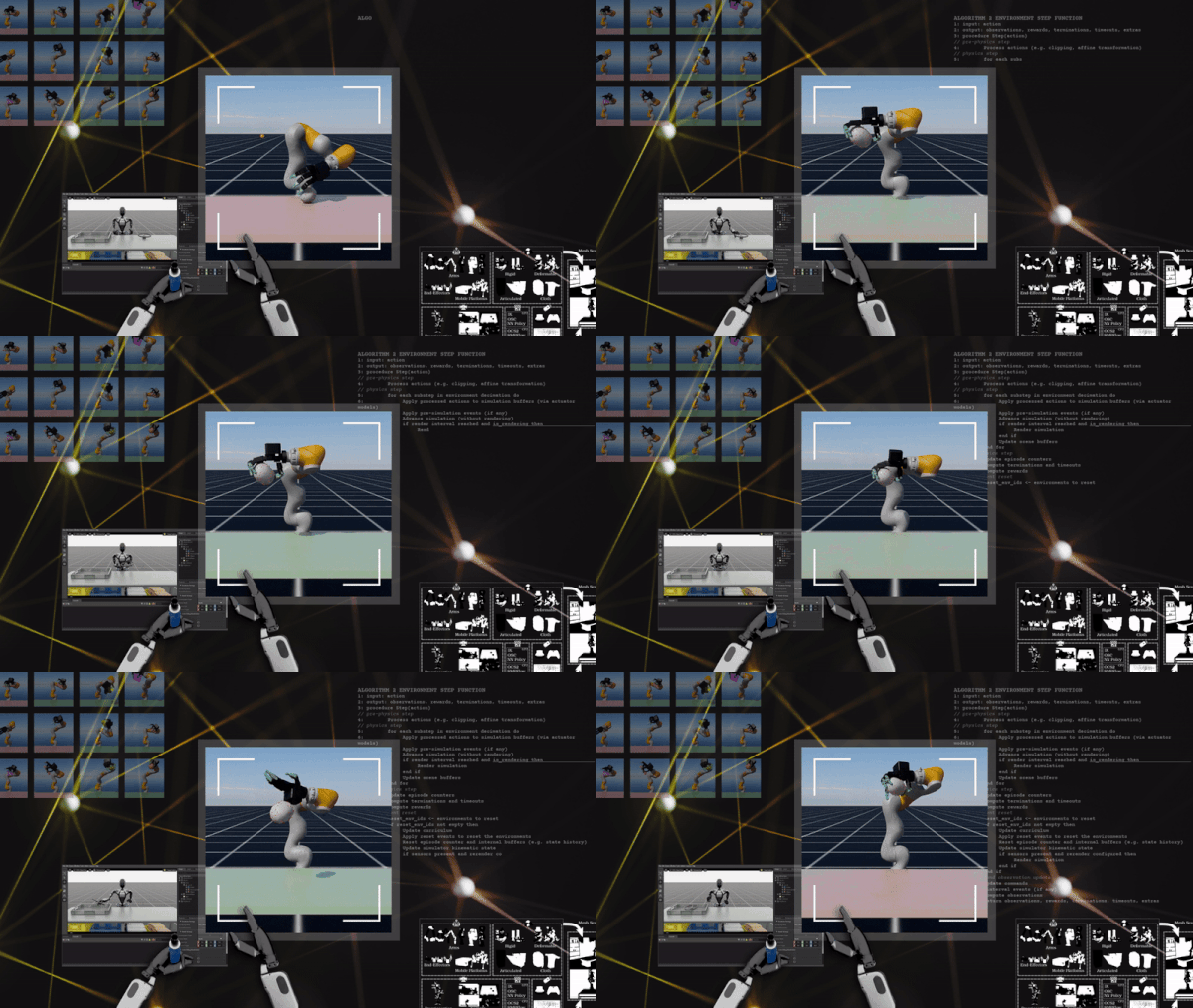
Robotics research is rapidly advancing as developers and scientists seek tools to train intelligent robots that can perform complex tasks in dynamic, real-world scenarios. A major breakthrough in this space comes from NVIDIA Isaac Lab, a GPU-accelerated simulation framework that makes it possible to scale robot learning efficiently and effectively. This technology helps address some of the biggest challenges in robotics today — from gathering diverse data safely to training multimodal artificial intelligence systems that can perceive, decide, and act.
What Is NVIDIA Isaac Lab?
Isaac Lab is an open-source, GPU-native simulation environment designed to unify the key components of robot learning — physics, rendering, sensing, and control — into a single, cohesive platform. By integrating all of these aspects, researchers and developers can simulate complex robotic tasks at scale without relying solely on expensive or risky real-world data collection.
The platform supports multimodal inputs such as visual, depth, and tactile sensors, enabling robots to learn in rich, varied environments. Because simulation runs entirely on GPUs, workflows like reinforcement learning and imitation learning can execute thousands of simulations in parallel — significantly accelerating progress.
Advancing Multimodal Robot Learning
Modern robots require multimodal learning — the ability to integrate and interpret information from multiple sources like vision, touch, and proprioception — to succeed in complex tasks. Isaac Lab facilitates this by providing synchronized sensor streams and integrated learning workflows that work seamlessly with popular reinforcement learning libraries.
One of the framework’s strengths is its modular design. Instead of building custom simulation environments from scratch, developers can compose reusable building blocks such as environments, robots, and sensors. This modularity reduces development time and allows robotics teams to focus more on high-level learning problems rather than low-level simulation engineering.
High-Performance Simulation for Faster Training
Isaac Lab’s GPU acceleration delivers massive performance improvements in robot training simulations. For example, hundreds of thousands of simulation frames per second are possible for tasks involving locomotion and manipulation — enabling training cycles that would otherwise take days or weeks to complete.
This high throughput empowers researchers to explore a broader range of scenarios and edge cases that are too costly or dangerous to test in physical hardware. It also supports better generalization, allowing learned policies to transfer more reliably from simulation to real robots — an essential milestone for real-world deployment.
Toward Generalist Robots
With tools like Isaac Lab, the robotics community is moving closer to creating generalist robots — machines that can adapt to diverse tasks and environments rather than being limited to narrow, preprogrammed functions. By scaling multimodal robot learning, this framework helps bridge the gap between simulated training and real-world application.
Overall, NVIDIA Isaac Lab represents a significant step forward in how robots are trained, tested, and evaluated — unlocking new possibilities for AI-powered robotics in industries ranging from manufacturing and logistics to healthcare and home assistance.
Source: https://developer.nvidia.com/blog/r2d2-scaling-multimodal-robot-learning-with-nvidia-isaac-lab/
Comments :