



Implementation of BeeLens Technology to Support Optometry Education at UKRIDA
The rapid advancement of educational technology continues to transform how practical skills are taught in higher education. In response to challenges faced in optometry practical training, a team from the Computer Engineering Department at BINUS University implemented an innovative technology solution called BeeLens at the Department of Optometry, Faculty of Medicine and Health Sciences, Universitas Kristen Krida Wacana (UKRIDA).
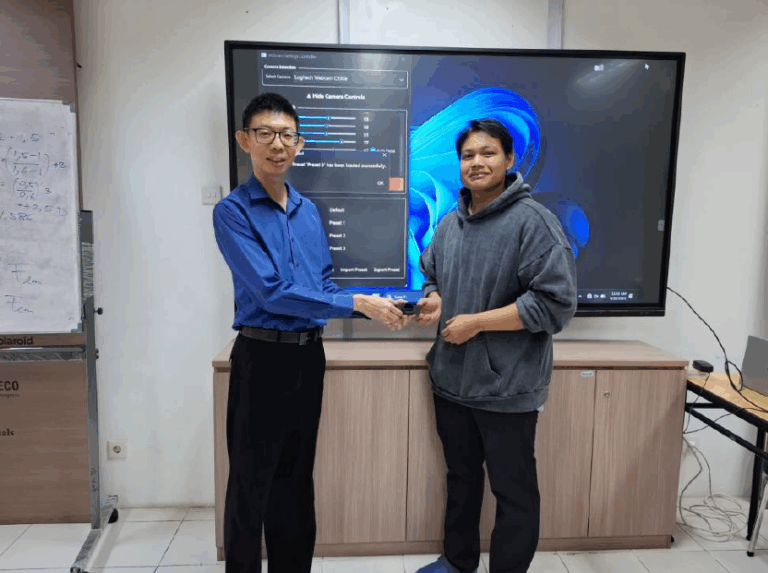
This initiative aims to improve the effectiveness of optometry education by enabling students to observe lens measurement processes simultaneously during practical sessions.
Addressing Challenges in Optometry Practical Training
One of the main challenges faced by the Department of Optometry at UKRIDA is the limited availability of lensometers, which are essential instruments used to measure optical lens parameters. Traditional lensometers are designed for single-user operation, meaning only one student can observe the measurement process at a time.
This limitation often leads to inefficient learning during practical sessions, especially in classrooms with many students. As a result, students may struggle to clearly understand the lens measurement procedures demonstrated by lecturers.
To overcome this issue, the BeeLens system was introduced as a technology-based solution that enables real-time visualization of lensometer measurements on a shared display.
BeeLens: A Smart Visualization System for Lens Measurement
BeeLens is designed as a camera-based visualization system that captures the image from a lensometer eyepiece and projects it onto an external monitor or display. By doing so, the measurement process can be observed by multiple students simultaneously during classroom demonstrations.
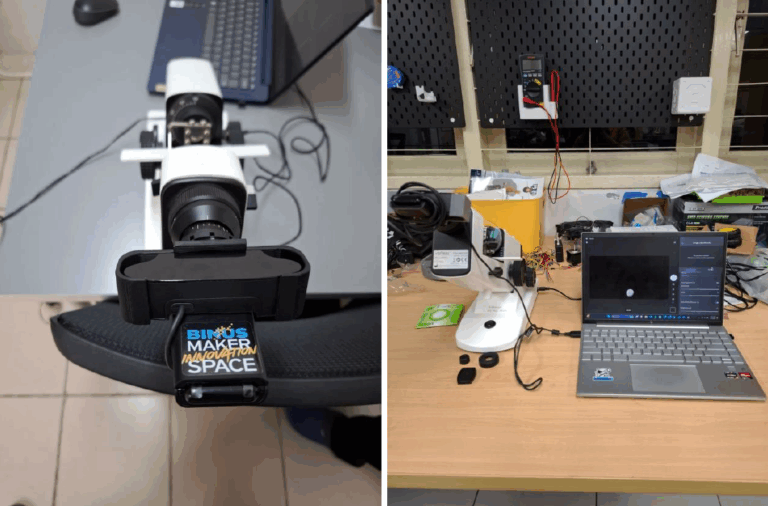
The system integrates several components, including:
- A digital camera with HD or Full HD resolution
- A custom mounting mechanism aligned with the lensometer eyepiece
- Video connection cables
- A display monitor for real-time visualization
- Supporting software for image display and configuration
Importantly, the BeeLens system is designed to be non-invasive, meaning it does not modify or interfere with the original optical instrument. This ensures that the existing lensometer can still function normally while benefiting from enhanced visualization.
Implementation Process
The BeeLens implementation was carried out through several stages to ensure successful adoption within the academic environment.
1. Needs Assessment and Coordination
The team first conducted discussions with lecturers and staff from the Department of Optometry to identify instructional challenges and determine the system requirements.
2. System Design and Preparation
The BeeLens system was then designed to integrate seamlessly with the existing lensometer equipment without altering its structure.
3. Installation and Alignment
A camera was mounted carefully on the lensometer eyepiece to capture measurement parameters clearly. The captured image was then connected to a monitor or projector for classroom display.
4. Testing and Calibration
Before implementation, the system underwent testing and calibration to ensure clear image quality and stable performance under classroom lighting conditions.
5. Training and Demonstration
Lecturers and students received a short orientation on how to use the system effectively during practical sessions.
6. Classroom Implementation
BeeLens was then integrated into regular optometry practical classes, allowing instructors to demonstrate lens measurements in real time for all students.
7. Evaluation and Feedback
Feedback was collected from lecturers and students to assess the system’s usability and educational effectiveness.
Positive Impact on Teaching and Learning
Since its implementation, BeeLens has significantly improved the teaching process during optometry practical sessions. Lecturers reported that they could explain measurement procedures more efficiently because students were able to observe the results simultaneously.
Students also expressed that the shared visualization helped them better understand lens measurement techniques and reduced confusion during demonstrations.
Follow-up monitoring confirmed that the system has been consistently used in practical classes and has contributed to improved classroom engagement and learning efficiency.
Comments :