


Indonesia Needs Millions More Digital Talents by 2030: Here’s Where You Fit In
Indonesia is one of the most digitally active countries in the world. More than 229 million people are online, and Indonesians use apps for everything from shopping and banking to ordering food and learning. But behind all those apps, networks, and devices, there’s a growing problem: the country doesn’t have enough skilled people to build and run them.
In August 2026, the government put a number on it: Indonesia faces a shortage of around 6 million digital talents by 2030. For students choosing a major right now, that’s not just a statistic. It’s a signal of where the opportunities will be. Here’s what the numbers say, which skills are in demand, and how you can prepare.
What the Numbers Say
On August 10, 2026, Deputy Minister of Communication and Digital Affairs Nezar Patria said Indonesia will need about 9 million digital talents by 2030. At the current pace, the country can only produce around 3 million, leaving a gap of roughly 6 million. He called for “strong collaboration between government, industry, and educational institutions” to close it.
Engineers are part of the same picture. At World Engineering Day 2026 in Jakarta on March 4, Coordinating Minister for Economic Affairs Airlangga Hartarto said Indonesia needs about 45% more engineers than it has today. He estimated the semiconductor industry alone needs around 15,000 engineers, while the digital industry needs about 150,000 engineers every year for the next six years.
The gap isn’t spread evenly either. The East Ventures Digital Competitiveness Index 2026, released in July, found that while most provinces became more digitally competitive, the human resources pillar actually dropped by 2.5 points. In other words, infrastructure is growing faster than the number of people who can make full use of it.
Which Skills Are in Demand
The news from 2026 points to a few clear areas. AI is the obvious one: companies and the government want people who can build, adapt, and run AI systems, including AI that understands Indonesian languages. Cybersecurity is another, which is why the government is partnering with private firms on cybersecurity and AI training programs.
Semiconductors and hardware are rising too. With the government citing a need for thousands of semiconductor engineers and new projects such as local GPU assembly, people who understand chips and electronics will be needed. Finally, data centers and networks are expanding fast, and every new facility needs engineers to design, operate, and secure its servers, networks, and power systems.
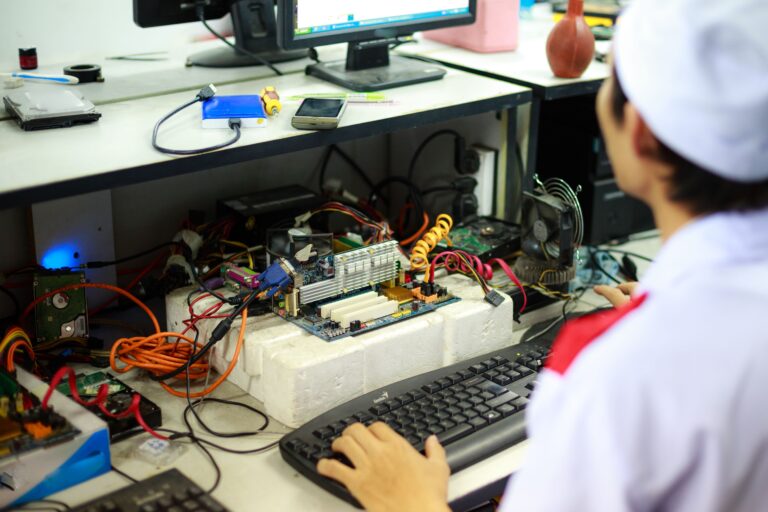
What these areas share is that they all mix hardware and software. An AI model needs chips to run on. A data center needs networks and security. A smart device needs both embedded hardware and the code that brings it to life.
Where You Fit In
If you enjoy figuring out how things work, both the physical device and the code inside it, computer engineering puts you right in the middle of these in-demand fields. You learn programming, digital circuits, computer architecture, embedded systems, and networking, which together cover a lot of what AI, semiconductor, and data center employers are looking for.
You can also start preparing before college. Learn the basics of a programming language like Python, try a beginner electronics kit or a microcontroller board, and follow tech news so you understand where the industry is heading. Joining a coding club, a robotics competition, or an online course is a great way to find out what you enjoy most.
Most importantly, keep in mind that the gap is a chance, not a threat. When a country needs millions more skilled people, those who prepare early will have more options, better jobs, and a real role in shaping Indonesia’s digital future.
Key Takeaways
Indonesia expects to need about 9 million digital talents by 2030 but is on track to produce only around 3 million, a gap of roughly 6 million. The government also says the country needs 45% more engineers, including about 15,000 for semiconductors and 150,000 a year for the digital industry. Skills in AI, cybersecurity, semiconductors, and data centers are in especially high demand, and they all combine hardware and software.
Ready to turn that gap into your opportunity? The Computer Engineering program at BINUS University prepares you with the hardware and software skills Indonesia’s digital economy needs. Explore the program and start building your future today.
Sources:
- Komdigi Gaet Sektor Swasta Tutup Defisit 6 Juta Talenta Digital pada 2030, Bisnis.com, 10 August 2026
- Indonesia Reinforces Engineering Sector for Sustainable Future, RRI, March 2026
- EV-DCI: Digital talent is key for Indonesia to advance in the AI era, East Ventures, 17 July 2026
Comments :