



3D Printer Extruders Explained: Direct Drive vs. Bowden—What’s the Difference ?
The Same Goal, Two Different Paths
https://www.drdflo.com/pages/Guides/How-to-Build-a-3D-Printer/Extruder.html
Every standard Fused Deposition Modeling (FDM) 3D printer—whether it costs $150 or $5,000—performs the exact same two-step choreography to turn a spool of plastic filament into a solid object:
- The Extruder (Cold End): A stepper motor and toothed drive gears grip solid 1.75 mm (or 2.85 mm) plastic filament and push it forward—or pull it backward—by tiny, measured fractions of a millimeter (Prusa Research, 2023).
- The Hotend (Melt Zone): A heated aluminum or copper block melts that incoming plastic at 190°C to 300°C+ and squeezes it through a tiny nozzle opening (typically 0.4 mm wide) onto the build plate (All3DP, 2024).
While almost all printers share those two ingredients, manufacturers split into two distinct camps over where to bolt the extruder motor. One design mounts the motor directly on top of the moving printhead (Direct Drive), while the other bolts the motor off to the side on the printer’s stationary frame and feeds filament through a long plastic tube (Bowden) (MatterHackers, 2023). That single placement decision changes everything from stringing and flexible-filament capability to maximum print speed—raising three practical questions for every maker: What’s the actual difference, why did Direct Drive take over modern printers, and is it always better?
Step 1: What Is the Difference? (How Each System Works)

https://kingroon.com/blogs/3d-print-101/what-is-the-advantage-of-a-direct-drive-extruder
Direct Drive Extruder: Short, Immediate Control
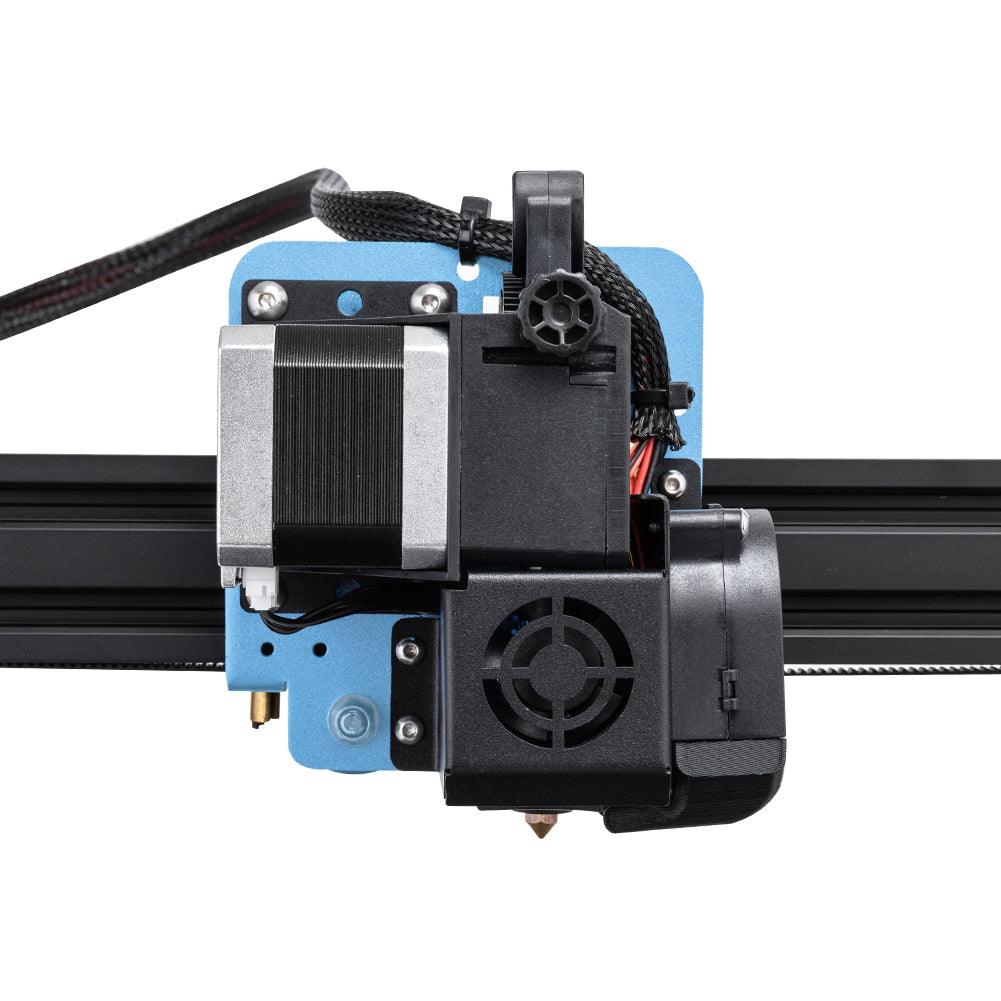
In a Direct Drive setup, the extruder motor and drive gears sit right on top of the moving printhead carriage, immediately above the hotend heatsink (Prusa Research, 2023). As soon as the filament leaves the drive gears, it travels straight down a short, rigid guide path—typically only 20 mm to 50 mm (1 to 2 inches)—directly into the hotend melt zone.
Because the drive gears are parked practically on top of the nozzle, every micro-step forward or backward from the stepper motor translates almost instantaneously into plastic pressure inside the nozzle.
Bowden Extruder: Remote Motor + Long PTFE Guide Tube
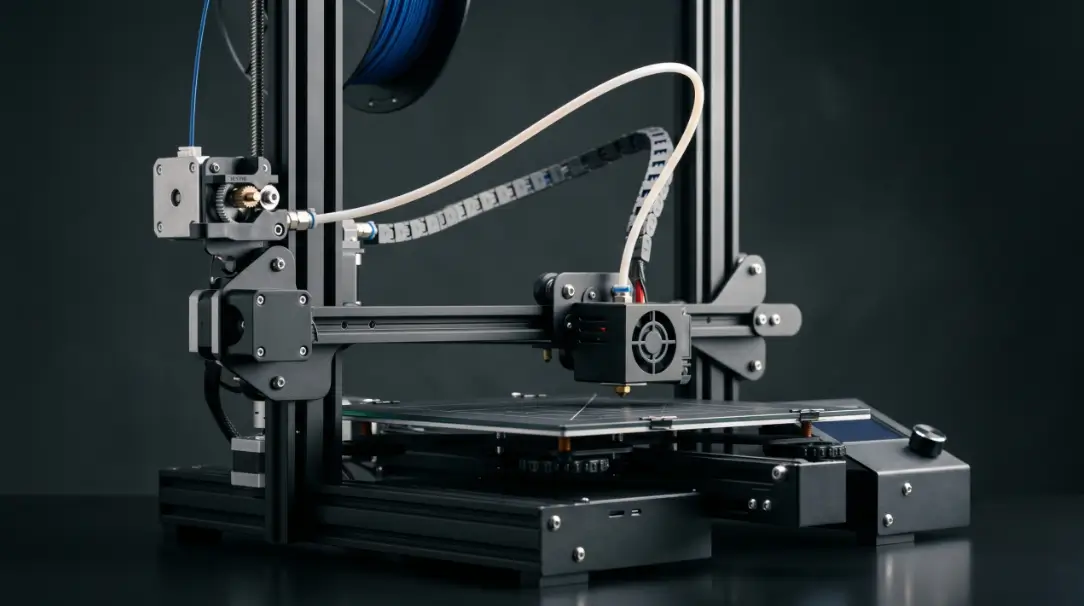
In a Bowden setup—named after the flexible Bowden cable invented in the 1890s to transmit mechanical force through a hollow sleeve on bicycle brakes—the heavy extruder motor is removed from the moving printhead and bolted onto the printer’s stationary frame (All3DP, 2024). To bridge the gap to the moving hotend, the motor pushes filament through a long, slippery PTFE (Polytetrafluoroethylene / Teflon) guide tube, typically 300 mm to 600 mm (12 to 24 inches) long (MatterHackers, 2023).
| Plain-English Analogy: Pushing a Noodle Through a Straw
Imagine trying to push a cooked spaghetti noodle onto a plate: |
Step 2: Why Choose Direct Drive? (Four Key Advantages)
https://www.sovol3d.com/blogs/news/direct-drive-vs-bowden-extruder
Over the past few years, flagship consumer and enthusiast 3D printers—from Prusa and Bambu Lab to Creality’s K-series and Sovol—have overwhelmingly converged on Direct Drive toolheads. Four practical printing advantages explain why:
- Superior Flexible Filament Printing (TPU & TPE): Rubbery filaments like TPU (Thermoplastic Polyurethane)—used for phone cases, drone camera mounts, gaskets, and vibration dampers—are soft and compressible. Inside a 40 cm Bowden tube (which typically has a 1.9–2.0 mm inner bore for 1.75 mm filament), soft TPU bends like a wet noodle, presses sideways against the tube walls, and frequently kinks or tangles around the drive gear. Because a Direct Drive extruder grips the filament and guides it straight into the melt zone across a gap of just a few millimeters, it feeds even ultra-soft 85A or 82A TPU reliably (MatterHackers, 2023; Prusa Research, 2023).
- Crisper Retraction & Far Less Stringing: When a printhead finishes one island of a model and travels across open air to start another, residual pressure inside the hotend tries to ooze thin cobwebs of plastic—known as stringing. To stop oozing, the extruder briefly pulls the filament backward (retraction). Because Direct Drive has virtually zero slack, it only needs 0.4 mm to 1.5 mm of retraction (at 25–45 mm/s) to relieve nozzle pressure cleanly. By contrast, a Bowden setup often needs 4.0 mm to 7.0+ mm of retraction just to take up the slack inside the PTFE tube—resulting in slower travel cycles, more stringing, and a higher risk of pulling melted plastic up into the cold heatsink and causing a clog (All3DP, 2024).
- Faster, More Responsive Extrusion Control: Every time the nozzle slows down for a sharp 90° corner or accelerates along a straight wall, plastic flow must adjust in lockstep. Direct Drive’s stiff, short filament path responds immediately to pressure changes, making sharp corners, fine text details, and firmware flow calibration (such as Pressure Advance or Linear Advance) much easier to dial in (Klipper Documentation, 2024).
- Easier Maintenance & Lower Motor Resistance: Pushing filament through a curved 50 cm PTFE tube adds continuous sliding friction, especially if the tube wears down or bends tightly at tall Z heights. Direct Drive eliminates long-tube friction—reducing wear on the drive gears and making it far easier to unload filament or clear a broken strand without unscrewing Bowden couplers (Prusa Research, 2023).
Step 3: Is Direct Drive Always Better? (Where Bowden Still Wins)
https://www.snapmaker.com/blog/what-is-bowden-extruder
With better flexible filament support, shorter retractions, and cleaner details, it is tempting to assume Direct Drive is automatically superior in every situation. In reality, the answer is no—because of one fundamental law of physics: inertia (F = m × a) (All3DP, 2024).
Toolhead Weight, Inertia, and “Ringing / Ghosting”
Bolting a traditional NEMA 17 stepper motor and metal extruder housing directly onto the moving printhead adds roughly 250 to 400 grams of extra moving mass. Every time that heavier printhead races across the bed at 150–300 mm/s and slams to a halt at a sharp corner, all that momentum pushes against the belts, linear rails, and printer frame.
Like a heavy car with soft suspension swerving abruptly, the printhead overshoots slightly and vibrates back and forth for a fraction of a second. Those tiny mechanical vibrations imprint faint wavy ripples onto the vertical walls of your print right next to corners and cutouts—a classic 3D printing defect called ringing or ghosting (Klipper Documentation, 2024; Prusa Research, 2023). On budget “bed-slinger” printers with single Z-axis leadscrews or flexible frames, heavy Direct Drive upgrades can force you to lower print speeds and accelerations to keep walls smooth.
Where Bowden Extruders Still Excel
Because a Bowden printhead carries only the compact hotend, aluminum heatsink, and cooling fans—often weighing under 80 to 120 grams—it retains clear advantages in specific scenarios (MatterHackers, 2023; All3DP, 2024):
- Ultra-Light Kinematics (Delta 3D Printers): Delta printers suspend the printhead from three lightweight carbon-fiber arms that dart across the build volume at high accelerations. Keeping the effector feather-light via a Bowden setup is essential for rapid, agile Delta motion.
- High-Speed Rigid-Plastic Printing (PLA & PETG) on Lighter Frames: If you primarily print rigid filaments like PLA or PETG—which don’t buckle in a PTFE tube—a well-tuned Bowden printer with quality Capricorn XS PTFE tubing can achieve fast travel speeds and low ringing without needing heavy-duty frame reinforcement.
- Lower Cost & Mechanical Simplicity: Mounting the motor on the stationary frame requires shorter motor wiring (less cable flexing and fatigue over thousands of print hours), simpler carriage brackets, and lower manufacturing cost—making Bowden a staple on entry-level kits.
| How Modern Printers Bridged the Gap: Pancake Motors & Input Shaping
Modern high-speed printers (such as Voron, Bambu Lab, and Prusa MK4/CORE One) largely solved Direct Drive’s weight penalty through two breakthroughs: |
Step 4: Direct Drive vs. Bowden Comparison Table
The table below summarizes the real-world engineering trade-offs between both extruder architectures:
| Feature / Metric | Direct Drive Extruder | Bowden Extruder |
| Motor Location & Filament Path | Mounted on moving printhead; very short path (20–50 mm) into hotend | Mounted on stationary printer frame; long PTFE guide tube (300–600 mm) |
| Moving Toolhead Weight | Heavier (~180–450 g depending on motor size) | Very Light (~70–130 g; hotend and fans only) |
| Retraction Distance | Very Short: 0.4–1.5 mm (fast, low clog risk) | Long: 4.0–7.0+ mm (needed to overcome tube slack) |
| Flexible Filaments (TPU / TPE) | Excellent — feeds soft 82A–95A TPU reliably without buckling | Difficult — soft filaments compress and kink inside the long tube |
| Stringing & Oozing Control | Superior — immediate nozzle pressure relief on travel moves | Moderate — tube hysteresis can cause oozing unless carefully tuned |
| High-Speed Ringing / Ghosting | Higher risk on unbraced frames (mitigated by pancake motors & Input Shaping) | Lower risk — low moving inertia allows crisp corners on lighter frames |
| Maintenance & Jam Clearing | Easy access to drive gears and short filament path | Requires disconnecting PTFE couplers; tube wear affects friction over time |
| Hardware Cost & Complexity | Slightly higher cost; heavier X-carriage and flexing motor cables | Lower cost; simpler carriage and stationary motor wiring |
| Best Suited For | All-around modern printing, TPU flexibles, abrasive composites & high-detail models | Delta printers, budget kits, and high-speed rigid PLA/PETG printing |
Step 5: Practical Buying & Upgrading Guide — Which Should You Choose?
Whether you are shopping for your first 3D printer or deciding if an aftermarket extruder upgrade is worth the effort, use these four practical rules of thumb:
- Choose Direct Drive if you want maximum versatility and zero material limits: If you plan to print TPU flexible parts, PETG, ASA, or carbon-fiber-filled filaments—or simply want clean prints with minimal stringing out of the box—modern lightweight Direct Drive printers are the clear standard.
- Choose (or keep) Bowden if you print rigid plastics on a lightweight or Delta frame: If you already own a reliable Bowden printer (such as an Ender 3 V2 or Delta machine) and mainly print PLA prototypes, upgrading to a quality dual-gear Bowden feeder and tight-tolerance Capricorn PTFE tubing delivers great results without adding weight to your X-axis.
- Watch out for heavy bolt-on Direct Drive conversions on single-Z printers: If you convert an older Bowden bed-slinger to Direct Drive, avoid mounting a heavy full-size NEMA 17 motor on a single-leadscrew Z gantry unless you also add a dual-Z leadscrew kit or choose a lightweight NEMA 14 pancake extruder (like an Orbiter or Sherpa Mini) so gantry sag and ringing do not degrade your print quality.
- Always re-tune retraction after switching architectures: Never run a 6 mm Bowden retraction profile on a Direct Drive extruder—pulling molten filament 6 mm upward into a Direct Drive heatbreak will quickly jam the cold zone. Drop retraction down to 6–1.2 mm immediately after converting (All3DP, 2024; Prusa Research, 2023).
References
All3DP. (2024). Direct drive vs. Bowden extruder: The differences explained. All3DP Academy. https://all3dp.com/2/direct-vs-bowden-extruder-technology-shootout/
Bondtech. (n.d.). Large Gears eXtruder (LGX) & dual-drive filament feeding technology documentation. Bondtech AB. https://www.bondtech.se/
E3D Online. (n.d.). E3D Hemera direct drive & Bowden extrusion system technical guide. E3D-Online Ltd. https://e3d-online.com/pages/hemera
Klipper Documentation. (2024). Pressure advance and resonance compensation (Input Shaper) tuning guides. Klipper3D. https://www.klipper3d.org/Pressure_Advance.html
MatterHackers. (2023). Extruders 101: A crash course on an essential component of your 3D printer (Direct Drive vs. Bowden). MatterHackers Knowledge Base. https://www.matterhackers.com/articles/extruders-101:-a-crash-course-on-an-essential-component-of-your-3d-printer
Prusa Research. (2023). Bowden vs. direct drive extruders: Pros, cons, and retraction settings. Prusa Knowledge Base. https://help.prusa3d.com/article/bowden-vs-direct-drive_1747
Comments :