



ESP32-S31 vs. ESP32-S3: What’s New, How They Differ ?
Evaluating RISC-V vs. Xtensa, Wi-Fi 6, Dual-Mode Bluetooth, 24-Bit PPA Graphics, Gigabit Ethernet, and Supply-Chain Reality
Why the ESP32-S31 Exists
ESP32 S31 Devboard, https://docs.espressif.com/projects/esp-dev-kits/en/latest/esp32s31/esp32-s31-function-coreboard-1/user_guide.html
Over the last several years, the ESP32-S3 has become the default microcontroller for smart displays, voice assistants, and edge AIoT devices—combining dual-core compute, vector AI instructions, and reliable Wi-Fi/BLE at an unbeatable module price (Elecrow, 2026). Meanwhile, when engineers needed heavier graphics or high-speed interfaces and looked at Espressif’s flagship ESP32-P4, they hit an immediate hardware headache: the P4 has no built-in wireless radio, forcing designers to wire up a secondary ESP32-C6 coprocessor over SDIO/SPI just to connect to Wi-Fi or Thread (Elecrow, 2026).
To bridge that exact gap, Espressif launched the ESP32-S31 into mass production on July 27, 2026 (Espressif Systems, 2026a). Rather than serving as a minor clock bump or a stripped-down P4, the S31 is designed as a “sweet-spot” single-chip wireless and multimedia hub. For developers deciding whether to stick with the proven S3 or design in the new S31, four questions matter most:
- How does the ESP32-S31 differ under the hood from the ESP32-S3?
- What are its headline hardware, wireless, and graphics upgrades?
- What does it actually cost, and can you easily buy bare chips or modules for PCB assembly today?
- And what real-world products is the ESP32-S31 genuinely built for?
Step 1: Core Architecture Shift — Xtensa LX7 (S3) vs. 320 MHz RISC-V (S31)
CPU Core, Clock Speed, and SIMD Compute
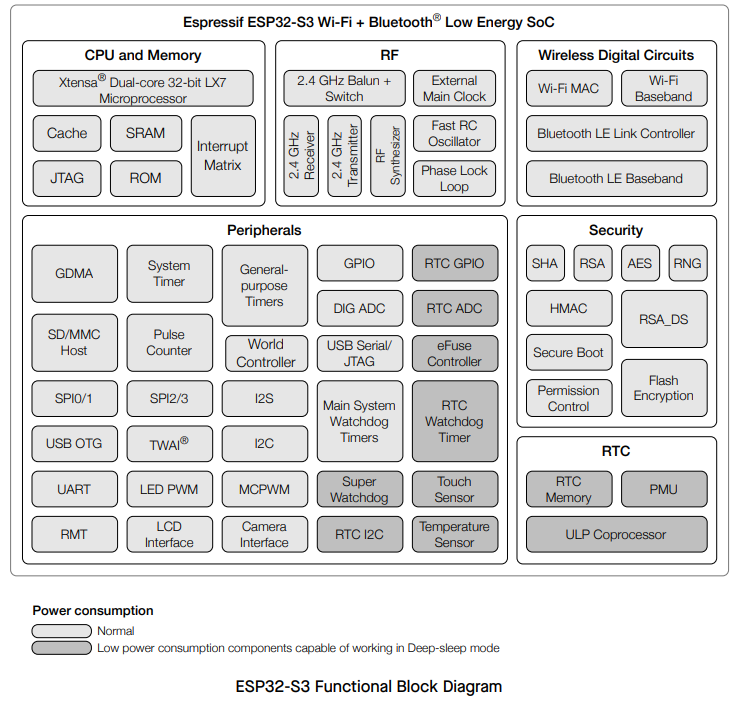
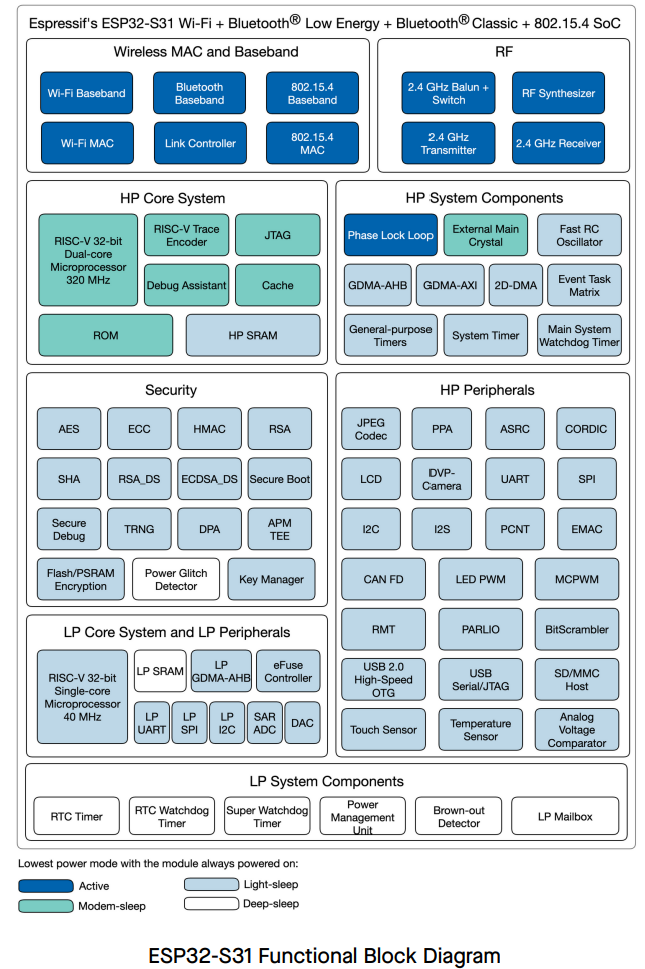
Despite sharing the “S3” family prefix, the two chips run completely different instruction set architectures (ISAs) (Espressif Systems, 2026b; VieweDisplay, 2026a):
- ESP32-S3 (Xtensa LX7): Uses a dual-core 32-bit Xtensa LX7 processor clocked up to 240 MHz with AI vector extensions, paired with a low-power RISC-V ULP coprocessor.
- ESP32-S31 (32-Bit RISC-V @ 320 MHz): Transitions fully to a dual-core 32-bit RISC-V processor running up to 320 MHz, achieving roughly 65% higher overall compute performance (~2,195 CoreMark at 6.86 CoreMark/MHz) than the S3 (Espressif Systems, 2026c; Elecrow, 2026). Notably, one of the two 320 MHz cores integrates a 128-bit data path and SIMD instruction set dedicated to edge AI neural-network inference and DSP workloads, while the second core handles wireless protocol stacks and application logic (Espressif Systems, 2026a).
High-Speed DDR PSRAM & Expanded 60-GPIO Footprint
Memory bandwidth and pin count are two of the biggest bottlenecks on modern display and gateway boards, and the S31 addresses both directly (Espressif Systems, 2026b; VieweDisplay, 2026a):
- 3× Faster In-Package DDR PSRAM: While the ESP32-S3 relies on an 80 MHz Octal SPI PSRAM bus (~160 MB/s peak theoretical transfer rate), the ESP32-S31 upgrades to an in-package 8-bit DDR PSRAM interface clocked at 250 MHz (~500 MB/s bandwidth—roughly triple the throughput of the S3). Note that because the 250 MHz DDR bus requires tightly matched in-package routing, PSRAM is in-package only (fixed by chip/module SKU) rather than expandable via external SPI pins (VieweDisplay, 2026a).
- 60 GPIOs in QFN80: The S31 moves from the S3’s 45 GPIOs (QFN56, 7×7 mm) to 60 GPIOs (QFN80, 8×8 mm)—giving engineers enough spare pins to drive a parallel RGB display and a DVP camera simultaneously without running out of I/O (Espressif Systems, 2026b, 2026c).
| Developer Caveat: Toolchain, Arduino & Precompiled Library Migration
Moving from Xtensa LX7 to RISC-V means existing precompiled .a binary libraries built for the ESP32-S3 will not link directly onto the ESP32-S31 without a RISC-V recompilation. Official support is mature in ESP-IDF (master / v6.1+) alongside ESP-Matter, ESP-SR, and ESP-BLE-AUDIO, whereas Arduino-ESP32 and MicroPython support is still catching up (Elecrow, 2026; NextEverything, 2026). |
Step 2: What Are the Major New Features on the ESP32-S31?

Beyond raw CPU MHz, the ESP32-S31 introduces four architectural upgrades that eliminate external companion chips on complex IoT products:
- All-in-One Next-Gen Wireless (Wi-Fi 6 + Thread/Zigbee + Dual-Mode Bluetooth)
- Wi-Fi 6 (802.11ax, 2.4 GHz): Upgrades from Wi-Fi 4 (11n) on the S3 to Wi-Fi 6 (2.4 GHz) with OFDMA and Target Wake Time (TWT), improving throughput stability in congested apartments/factories and extending battery life (Espressif Systems, 2026a).
- Native IEEE 802.15.4 (Thread & Zigbee): Integrates an 15.4 radio directly on-chip (previously only found on the C6/H2), enabling single-chip Matter over Thread end devices and Thread Border Routers without wiring a separate radio IC (Elecrow, 2026).
- Dual-Mode Bluetooth 5.4 (LE Audio + Bluetooth Classic BR/EDR): The ESP32-S3 supported Bluetooth Low Energy (BLE) only, dropping legacy Bluetooth Classic. The ESP32-S31 is the only modern Espressif SoC supporting both Bluetooth 5.4 LE Audio and Bluetooth Classic (BR/EDR) simultaneously—solving a long-standing pain point for wireless speakers, headsets, and legacy serial/audio accessories (VieweDisplay, 2026a).
- True Hardware Graphics Pipeline & 24-Bit Display Color
On the ESP32-S3, rotating a screen by 90°, scaling icons, or alpha-blending UI overlays consumes heavy CPU cycles, and parallel RGB output tops out at 16-bit RGB565 (65,536 colors), which often shows visible color banding on smooth gradients. The ESP32-S31 adds a complete hardware 2D graphics pipeline (Espressif Systems, 2026d; VieweDisplay, 2026a):
- Pixel Processing Accelerator (PPA): Offloads 0°/90°/180°/270° rotation, mirroring, fractional scaling, and alpha-channel layer blending in hardware with zero CPU overhead.
- 2D-DMA & Hardware JPEG Codec: Accelerates rectangular memory transfers and hardware MJPEG encoding/decoding for smooth camera previews and UI animations.
- Native 24-Bit RGB888 Output: Supports 16.7 million colors over 8- to 24-bit parallel RGB interfaces. In Espressif’s LVGL benchmarks, the S31 sustains 50 FPS on 800×480 panels and 43 FPS (RGB565) / 34 FPS (RGB888) on 1024×600 displays—while leaving a full CPU core free for application tasks (VieweDisplay, 2026a, 2026b).
- Industrial & High-Speed Wired Connectivity
- Gigabit Ethernet MAC (10/100/1000 Mbps): The first chip in the S-series to include an integrated Gigabit Ethernet MAC (requiring only an external RGMII/RMII PHY chip and RJ45 magnetics) for low-latency wired backhaul (Espressif Systems, 2026b, 2026e).
- USB 2.0 High-Speed OTG (480 Mbps): Delivers 40× faster USB bandwidth than the ESP32-S3’s 12 Mbps Full-Speed USB interface, unlocking high-rate data logging, UVC cameras, and fast firmware/storage transfers (VieweDisplay, 2026a).
- CAN FD Controller: Upgrades the S3’s classic TWAI (CAN 2.0) peripheral to CAN FD (Flexible Data-Rate) for modern robotics, automotive diagnostics, and industrial automation buses (Espressif Systems, 2026b).
- Upgraded Hardware Security
For commercial Matter and enterprise deployments, the S31 upgrades Espressif’s security subsystem with a hardware Trusted Execution Environment (TEE) backed by Access Permission Management (APM) and a RAM-based Physically Unclonable Function (PUF) for device-unique cryptographic root keys, alongside hardware AES/SHA/RSA/ECC accelerators and flash/PSRAM encryption (Espressif Systems, 2026a).
Step 3: Side-by-Side Comparison Table (ESP32-S3 vs. ESP32-S31)
The table below summarizes every major architectural, wireless, multimedia, and ecosystem difference between the established ESP32-S3 and the newer ESP32-S31 (Espressif Systems, 2026b; Elecrow, 2026; VieweDisplay, 2026a):
| Feature / Specification | ESP32-S3 (Proven Workhorse) | ESP32-S31 (2026 Next-Gen Hub) |
| CPU Architecture & Max Clock | Dual-core 32-bit Xtensa LX7 @ up to 240 MHz (+ RISC-V ULP coprocessor) | Dual-core 32-bit RISC-V @ up to 320 MHz (~65% higher compute; 128-bit SIMD AI core) |
| Wi-Fi & Thread / Zigbee | Wi-Fi 4 (802.11n, 2.4 GHz) only; no native 802.15.4 radio | Wi-Fi 6 (802.11ax, 2.4 GHz) + native IEEE 802.15.4 (Thread & Zigbee) |
| Bluetooth Support | Bluetooth 5.0 (BLE) only (no Bluetooth Classic audio) | Bluetooth 5.4 LE Audio + Bluetooth Classic (BR/EDR) dual-mode |
| Display & Graphics Acceleration | Up to 16-bit parallel RGB565; CPU-bound rotation, scaling & blending | Up to 24-bit parallel RGB888 + hardware PPA, 2D-DMA & JPEG codec (43–50 FPS) |
| PSRAM Interface | External or in-package Octal SPI @ 80 MHz (~160 MB/s bandwidth) | In-package 8-bit DDR PSRAM @ 250 MHz (~500 MB/s bandwidth; fixed by SKU) |
| Wired Peripherals & GPIOs | USB 1.1 Full-Speed (12 Mbps), CAN 2.0 (TWAI), no Ethernet MAC, 45 GPIOs (QFN56) | Gigabit Ethernet MAC, USB 2.0 High-Speed OTG (480 Mbps), CAN FD, 60 GPIOs (QFN80) |
| Software Ecosystem Maturity | Highly mature across ESP-IDF, Arduino-ESP32, MicroPython & PlatformIO | Supported in ESP-IDF (v6.1+ / master); Arduino-ESP32 & MicroPython pending |
Step 4: Price & Real-World Availability (The Honest Supply-Chain Check)
On paper, the ESP32-S31 looks like an easy upgrade—but if you are laying out a PCB for production or turnkey PCBA assembly right now, supply-chain reality is the deciding factor (NextEverything, 2026):
- ESP32-S3 Pricing & Stock (Immediate Turnkey Availability): The ESP32-S3 has been in volume production for years with finalized datasheets and deep global inventory across DigiKey, Mouser, and JLCPCB/LCSC. In 100-piece quantities, bare ESP32-S3 chips cost roughly $1.85 to $2.10 (with ESP32-S3R8 8 MB PSRAM variants around $2.28–$2.51), while pre-certified ESP32-S3-WROOM-1 modules (N8R8 and N16R8) cost roughly $3.65 to $5.10 and are stocked in tens of thousands of units for immediate automated assembly (NextEverything, 2026).
- ESP32-S31 Pricing & Stock Reality (Ramping Up): Although Espressif announced mass production of the ESP32-S31 on July 27, 2026, released official modules (ESP32-S31-WROOM-1 / -1U and ESP32-S31-WROOM-3 / -3U), and launched official dev kits—including the modular ESP-Mosaico, ESP32-S31-Function-CoreBoard-1, and ESP32-S31-Korvo-1 via Espressif’s official AliExpress store (with bare chips launching around $4.51 in single-unit retail listings)—channel distribution into Western and turnkey PCBA catalogs (DigiKey, Mouser, JLCPCB/LCSC) is still ramping up, and the SoC datasheet remains marked preliminary (Espressif Systems, 2026a, 2026e; NextEverything, 2026; QuadMeUp, 2026).
Practical takeaway: Do not freeze a mass-production PCB around the ESP32-S31 until you have verified module stock and lead times directly with your distributor or Espressif sales representative.
Step 5: Purpose & Real-World Use Cases (What Is the ESP32-S31 Actually For?)
The ESP32-S31 is built specifically to replace expensive multi-chip BOMs—such as pairing an ESP32-P4 + ESP32-C6, or combining a standard microcontroller with an external Ethernet MAC, a Bluetooth Classic audio codec, and a Thread radio—with a single integrated SoC (Elecrow, 2026). Its five prime real-world applications are:
- Single-Chip Matter, Thread & Wi-Fi 6 Smart-Home Hubs: Acting as a Matter controller or Thread Border Router that bridges low-power 802.15.4 mesh sensors directly to Wi-Fi 6 or wired Gigabit Ethernet.
- Fluid 24-Bit Smart Control Panels & Industrial HMIs: Driving 800×480 to 1024×600 capacitive wall thermostats, appliance interfaces, and compact handheld controllers (like the ESP-Mosaico platform) with smooth 24-bit RGB888 gradients and hardware-accelerated LVGL screen transitions (Espressif Systems, 2026d; VieweDisplay, 2026a).
- Dual-Mode Bluetooth Audio & Smart Speakers: Building connected speakers, intercoms, and voice assistants that stream audio over Bluetooth Classic (A2DP) or Bluetooth 5.4 LE Audio while maintaining Wi-Fi 6 cloud connectivity and local wake-word detection (Espressif Systems, 2026e).
- Wired Industrial & Commercial Gateways: Factory telemetry nodes, building automation controllers, and EV/robotics interfaces that combine Gigabit Ethernet MAC + CAN FD + USB 2.0 High-Speed on one chip (Espressif Systems, 2026b).
- Smart Locks & DVP Camera Panels: Capturing 8/16-bit DVP parallel camera frames with zero-CPU hardware JPEG compression and 128-bit SIMD edge AI processing (Elecrow, 2026).
| Quick 3-Rule Selection Guide: ESP32-S3 vs. ESP32-S31 vs. ESP32-P4
• Pick ESP32-S3 when you want the lowest BOM cost (~$1.85–$3.75), immediate JLCPCB/DigiKey/Mouser stock, and mature Arduino, MicroPython, or ESP-IDF libraries for standard Wi-Fi 4 + BLE + 16-bit display projects. |
References
Elecrow. (2026, August 14). ESP32-S31 vs S3 vs P4: Complete 2026 selection guide. https://www.elecrow.com/blog/esp32-s31-vs-s3-vs-p4-complete-2026-selection-guide.html
Espressif Systems. (2026a, July 27). ESP32-S31 now in mass production and available for purchase. https://www.espressif.com/en/news/ESP32_S31_Mass_Production
Espressif Systems. (2026b). ESP32-S31 series datasheet (Preliminary): Functional block diagram, GPIO matrix, Ethernet MAC, and CAN FD specifications. https://documentation.espressif.com/esp32-s31_datasheet_en.html
Espressif Systems. (2026c). How capable is ESP32-S31? Real-world benchmarks from the ESP developer platform. https://esp32-s31.espressif.com/en/official-projects/1
Espressif Systems. (2026d). Application solution series: HMI scenarios (RGB888 native output and PPA graphics acceleration). https://esp32-s31.espressif.com/en/official-projects/4
Espressif Systems. (2026e, November 17). ESP32-S31 development kits user guide (ESP32-S31-Function-CoreBoard-1, ESP32-S31-Korvo-1, and ESP-Mosaico). https://docs.espressif.com/projects/esp-dev-kits/en/latest/esp32s31/esp-dev-kits-en-master-esp32s31.pdf
NextEverything. (2026, October 25). ESP32-S31 vs ESP32-S3: Price and availability in October 2026. https://nexteverything.io/guides/esp32-s31-vs-esp32-s3-price-availability/
QuadMeUp. (2026, November 9). ESP32-S31: Specs, architecture and ESP32-S3/C3 comparison. https://blog.quadmeup.com/2026/11/09/esp32-s31-specs-architecture-and-esp32-s3-c3-comparison/
Seeed Studio. (2026, April 14). ESP32-S31 vs. ESP32-S3: Should the XIAO get an upgrade? https://www.seeedstudio.com/blog/2026/04/14/esp32-s31-vs-esp32-s3-should-the-xiao-get-an-upgrade/
VieweDisplay. (2026a, October 6). ESP32-S31 vs ESP32-S3: 320MHz RISC-V architecture, PPA graphics pipeline, and RGB888 comparison. https://viewedisplay.com/esp32-s31-vs-esp32-s3/
VieweDisplay. (2026b, October 30). ESP32-S31 vs ESP32-P4: MIPI DSI, measured frame rates and the architectural trade-offs. https://viewedisplay.com/esp32-s31-vs-esp32-p4/
Comments :