


ESP32-P4 Espressif’s Non-Wireless Powerhouse
ESP32-P4 vs. ESP32-S3: What Is Espressif’s Non-Wireless Powerhouse, What Are Its Features, and What Is It Built For?
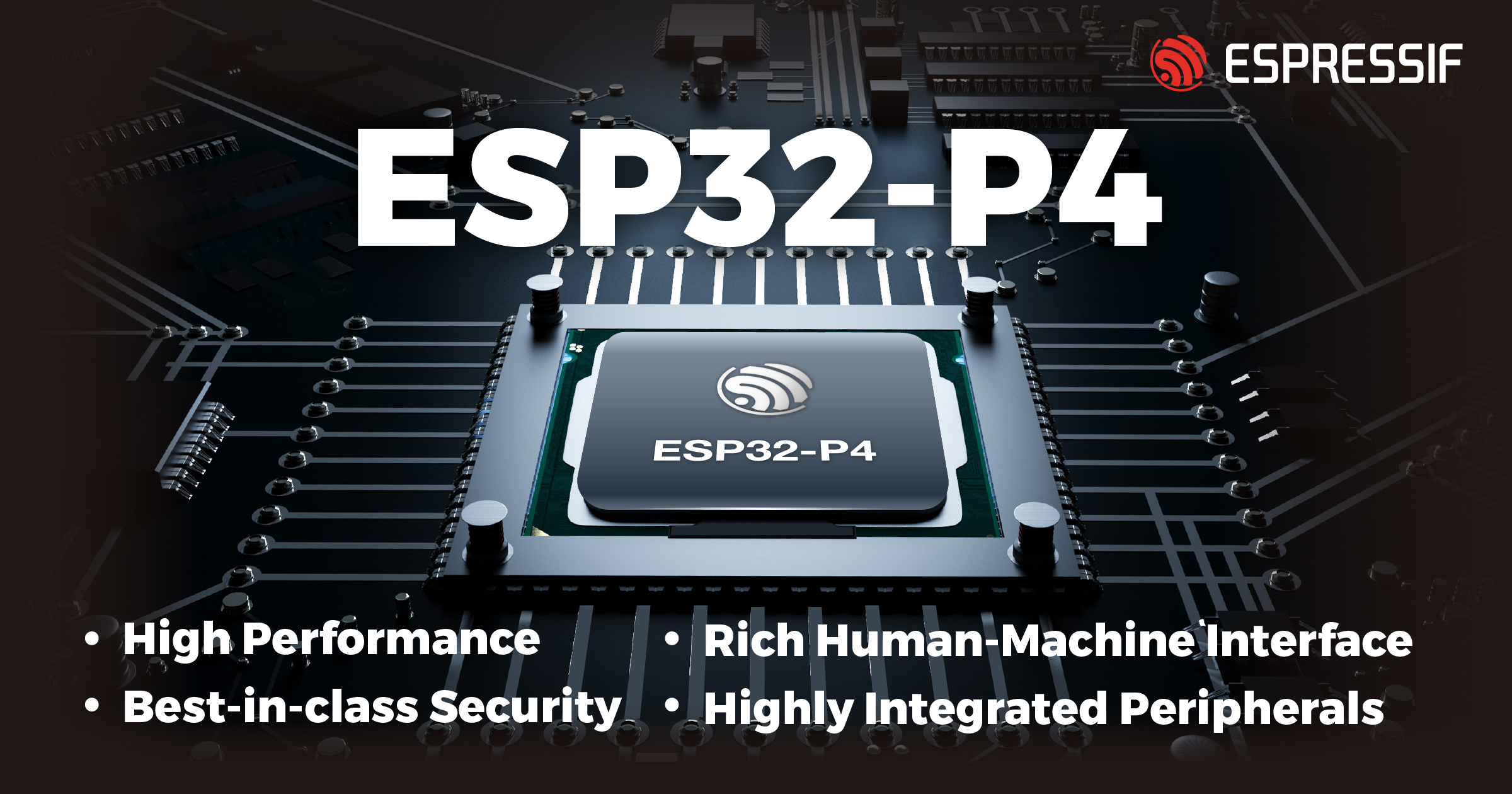
https://www.espressif.com/en/news/ESP32-P4
Open the ESP32-P4 datasheet and you immediately hit a surprise: for over a decade, “ESP32” meant an affordable microcontroller with built-in Wi-Fi and Bluetooth, yet the ESP32-P4 has zero built-in wireless radios. Espressif made that deliberate architectural trade-off to eliminate RF analog interference and silicon area constraints. By stripping out the radio transceiver, Espressif built a dedicated high-performance multimedia, display, and edge-AI microcontroller that pairs with an external wireless chip (ESP32-C6, ESP32-C5, or ESP32-S3) only when connectivity is required.
Step 1: What Is the ESP32-P4? (Architecture & Core Design)

ESP32-P4 Diagram Overview, https://viewedisplay.com/esp32-p4-specs/
Dual-Core 400 MHz RISC-V + Low-Power Core
The ESP32-P4 features a 32-bit dual-core RISC-V High-Performance (HP) processor running up to 400 MHz (upgraded from 360 MHz to a stable 400 MHz in the May 2026v3.x silicon revision) with single-precision FPU and AI vector extensions. A separate 40 MHz single-core RISC-V Low-Power (LP) core manages sensors and wake events while the main cores sleep.
Massive On-Chip Memory & In-Package PSRAM
To prevent frame-buffer bottlenecks on high-resolution screens, Espressif equipped the P4 with 768 KB of internal HP SRAM (plus8 KB zero-wait TCM and 32 KB LP SRAM) alongside 16 MB or 32 MB of high-speed in-package PSRAM in ESP32-P4NRW16 and ESP32-P4NRW32 variants.
Why Wireless Was Decoupled
Decoupling the radio lets hardware engineers choose the exact wireless protocol their BOM needs—ESP32-C6 for Wi-Fi 6/Thread, ESP32-C5 for dual-band 5 GHz Wi-Fi, or cellular/LoRa—over SDIO, SPI, or UART using ESP-Hosted or ESP-AT. Offline industrial devices also skip costly wireless RF compliance testing.
Step 2: Standout Hardware Features of the ESP32-P4

ESP32 P4 Display Devboard, https://doc.embedded-wizard.de/getting-started-esp32-p4-function-ev-board
Four hardware subsystems separate the ESP32-P4 from traditional Wi-Fi microcontrollers and bring it closer to an embedded application processor:- Smartphone-Grade Camera & Display Interfaces (MIPI-CSI & MIPI-DSI): As Espressif’s first SoC with native 2-lane MIPI-CSI (paired with an integrated Image Signal Processor / ISP) and 2-lane MIPI-DSI, the P4 drives crisp 1080p displays and cameras over a few high-speed differential pairs—while retaining legacy 24-bit RGB and 16-bit DVP parallel ports.
- Hardware Video Compression & 2D Graphics Acceleration: A dedicated hardware H.264 video encoder (up to 1080p @ 30 fps) and JPEG codec compress HD video streams without saturating the RISC-V cores. Meanwhile, the Pixel Processing Accelerator (PPA) and 2D-DMA offload image rotation, scaling, alpha blending, and YUV/RGB color conversion for fluid 60 fps LVGL interfaces.
- High-Speed Wired Connectivity & Massive I/O (55 GPIOs): Housed in a QFN104 (10×10 mm) package, the P4 expands to 55 programmable GPIOs and adds USB 2.0 High-Speed OTG (480 Mbps) alongside a separate USB Full-Speed port, a 100 Mbps Ethernet MAC (RMII),
SDMMC 3.0,I3C,MCPWM(motor control PWM),TWAI (CAN), and 14 capacitive touch channels. - Enterprise-Grade Hardware Security: Beyond Secure Boot and XTS-AES external flash/PSRAM encryption, the P4 integrates an SRAM Physically Unclonable Function (PUF) key manager, RSA/ECDSA (P-384) digital signature accelerators, and hardware Access Permission Management (APM) for privilege separation.
Step 3: ESP32-P4 vs. ESP32-S3 — Key Differences Side-by-Side
In practical system design, the ESP32-S3 is an “All-in-One Connected Generalist”, whereas the ESP32-P4 is a “High-Compute Multimedia & HMI Specialist.” Compare their architectural specifications directly below:| Specification / Feature | ESP32-S3 (Connected Generalist) | ESP32-P4 (Multimedia & Compute Specialist) |
|---|---|---|
| CPU Architecture & Max Clock | Dual-core Xtensa LX7 @ 240 MHz + ULP RISC-V/FSM coprocessor. | Dual-core 32-bit RISC-V @ 400 MHz (v3.x) + 40 MHz LP RISC-V core. |
| Built-In Wireless | 2.4 GHz Wi-Fi 4 (802.11n) + Bluetooth 5 (LE) integrated on-chip. | None — pairs with external ESP32-C6, ESP32-C5, or cellular via SDIO/SPI. |
| On-Chip SRAM & PSRAM | 512 KB internal SRAM + up to 8–16 MB external Octal SPI PSRAM. | 768 KB internal HP SRAM + 16 MB or 32 MB high-speed in-package PSRAM. |
| Display Interfaces & GPU | Parallel RGB / SPI / I8080 up to ~800×480; CPU-rendered graphics. | 2-lane MIPI-DSI + 24-bit RGB + hardware 2D PPA GPU up to 1080p. |
| Camera & Video Codec | 8/16-bit DVP parallel camera; software/basic MJPEG encoding only. | 2-lane MIPI-CSI + integrated ISP + Hardware H.264 1080p@30fps encoder. |
| USB, Ethernet & GPIOs | USB 1.1 Full-Speed (12 Mbps), no Ethernet MAC, 45 programmable GPIOs. | USB 2.0 High-Speed (480 Mbps), 100 Mbps Ethernet MAC, 55 GPIOs. |
| Ecosystem Maturity | Fully mature across ESP-IDF, Arduino-ESP32, MicroPython, and CircuitPython. | Mature in ESP-IDF & MicroPython (v1.27+); Arduino-ESP32 support maturing. |
Step 4: What Is the ESP32-P4 Actually Used For? (Real-World Applications)
Choosing between the ESP32-P4 and ESP32-S3 comes down to whether your bottleneck is pixel and video throughput or single-chip wireless simplicity:- Large Smart-Home Control Panels & Industrial HMIs: Wall-mounted 5-inch to 10-inch capacitive touchscreens running 60 fps LVGL dashboards leverage the P4’s
MIPI-DSIport, 32 MB in-package PSRAM, and 2D PPA graphics accelerator without screen tearing or CPU lag. - Smart Doorbells, Dashcams & IP Security Cameras: Combining
MIPI-CSIsensor input, the on-chipISP, and the hardware H.264 1080p@30fps encoder allows low-power video recording to SD cards or streaming over Ethernet or an externalESP32-C6Wi-Fi 6 link. - Edge-AI Voice & Vision Terminals: Dual-core 400 MHz RISC-V AI vector instructions, Voice Activity Detection (VAD), and 768 KB SRAM run local wake-word recognition, facial detection, and lightweight object classification without cloud latency.
- High-Speed USB, Ethernet & Robotics Controllers: With USB 2.0 High-Speed (480 Mbps), 100 Mbps Ethernet,
MCPWM, andCAN (TWAI), the P4 excels in wired factory automation gateways, USB audio/video bridges, and multi-axis motor controllers. - When to Still Choose the ESP32-S3: For compact battery-powered Wi-Fi/BLE sensors, smart plugs, wearables, or smaller SPI/RGB displays (up to 480×480), the ESP32-S3 remains cheaper, requires fewer PCB components, and avoids multi-chip firmware orchestration.
Quick FAQ & Key Takeaways
|
References
- Espressif Systems. (2026a). ESP32-P4 high-performance SoC product overview and hardware specifications. https://www.espressif.com/en/products/socs/esp32-p4
- Espressif Systems. (2026b, May 8). ESP32-P4 chip upgrade (v3.x): Performance and multimedia experience enhancement. https://www.espressif.com/en/news/ESP32_P4_v3.x_Upgrade
- Espressif Systems. (2026c). ESP32-P4 series datasheet: Dual-core 400 MHz RISC-V MCU with MIPI-CSI/DSI and H.264 encoder. https://documentation.espressif.com/esp32-p4_datasheet_en.pdf
- Espressif Systems. (2026d). ESP32-P4-Function-EV-Board v1.5.2 hardware reference and user guide. https://docs.espressif.com/projects/esp-dev-kits/en/latest/esp32p4/esp32-p4-function-ev-board/user_guide.html
- MicroPython. (2026). MicroPython firmware and port documentation for ESP32-P4 (ESP32_GENERIC_P4). https://micropython.org/download/ESP32_GENERIC_P4/
Comments :